
Quick Verdict: Which Booking Site Fits Your Journey
AI-generated illustration — not a retailer product photo.
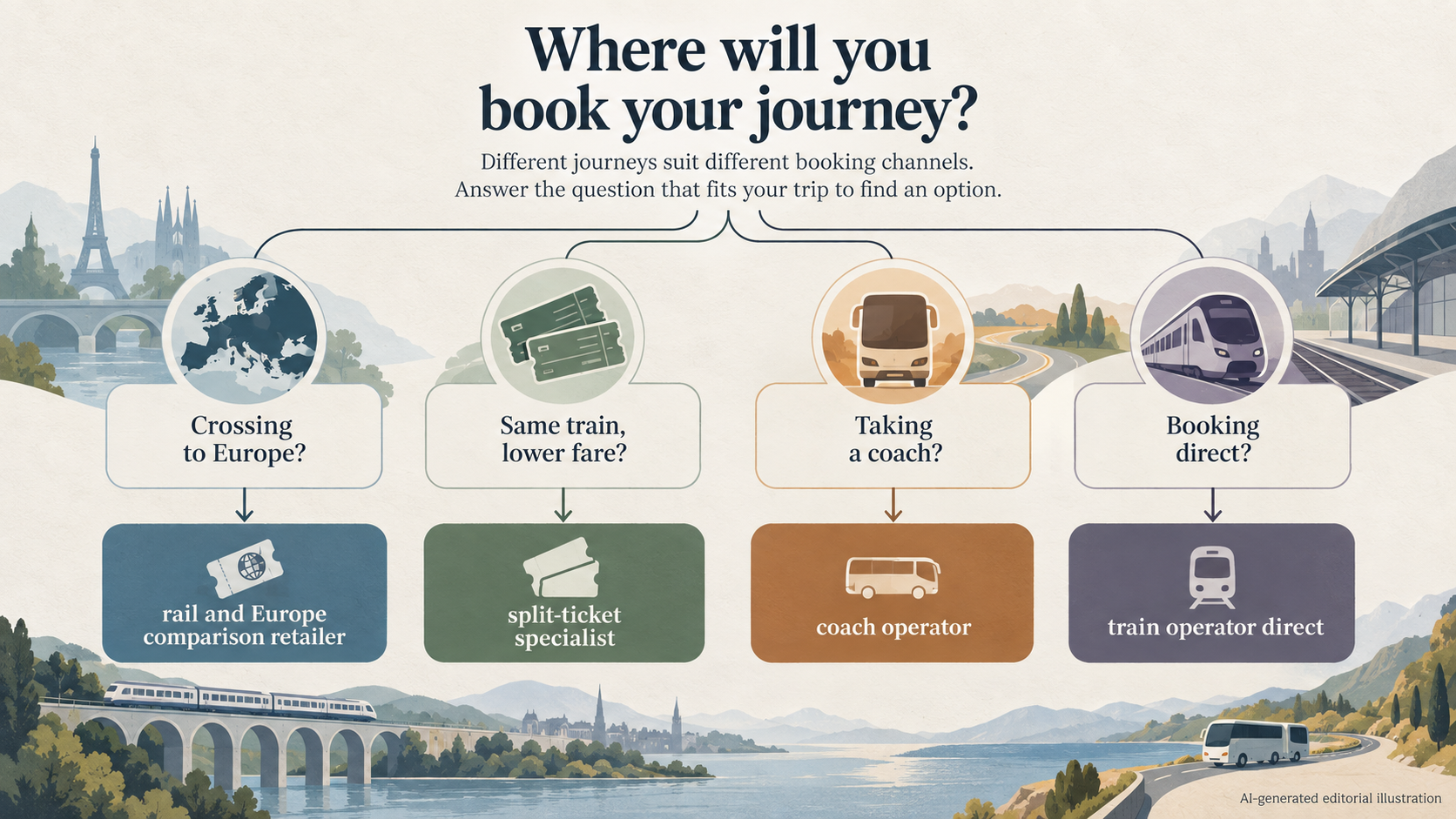
No single site wins every trip. The best choice depends on your route, how much flexibility you need and when you book. As a starting point:
- Comparing UK rail and European routes in one place: Trainline. Its own pages present it as somewhere to compare prices and book UK and European train tickets.
- A domestic rail journey where splitting the ticket may cut the total price: Split My Fare, a specialist that searches advance and split fares.
- A coach journey: National Express, the coach-specific channel in this set.
- A Eurostar trip to the continent: Eurostar direct, the primary source for Eurostar fares and for its exchange and refund conditions.
One honest caveat: this verdict rests on each provider's published terms and on independent editorial sources, namely Seat61 and Railfuture. We have not booked tickets, run live price comparisons or tested customer service for this guide, so we do not rank the sites on price or service quality.
If you are unsure whether you need an Advance, Off-Peak or Anytime ticket, read the ticket types section below before you choose a site. Then check fees, restrictions and refund terms at checkout.
What Each Booking Channel Is For
AI-generated illustration — not a retailer product photo.
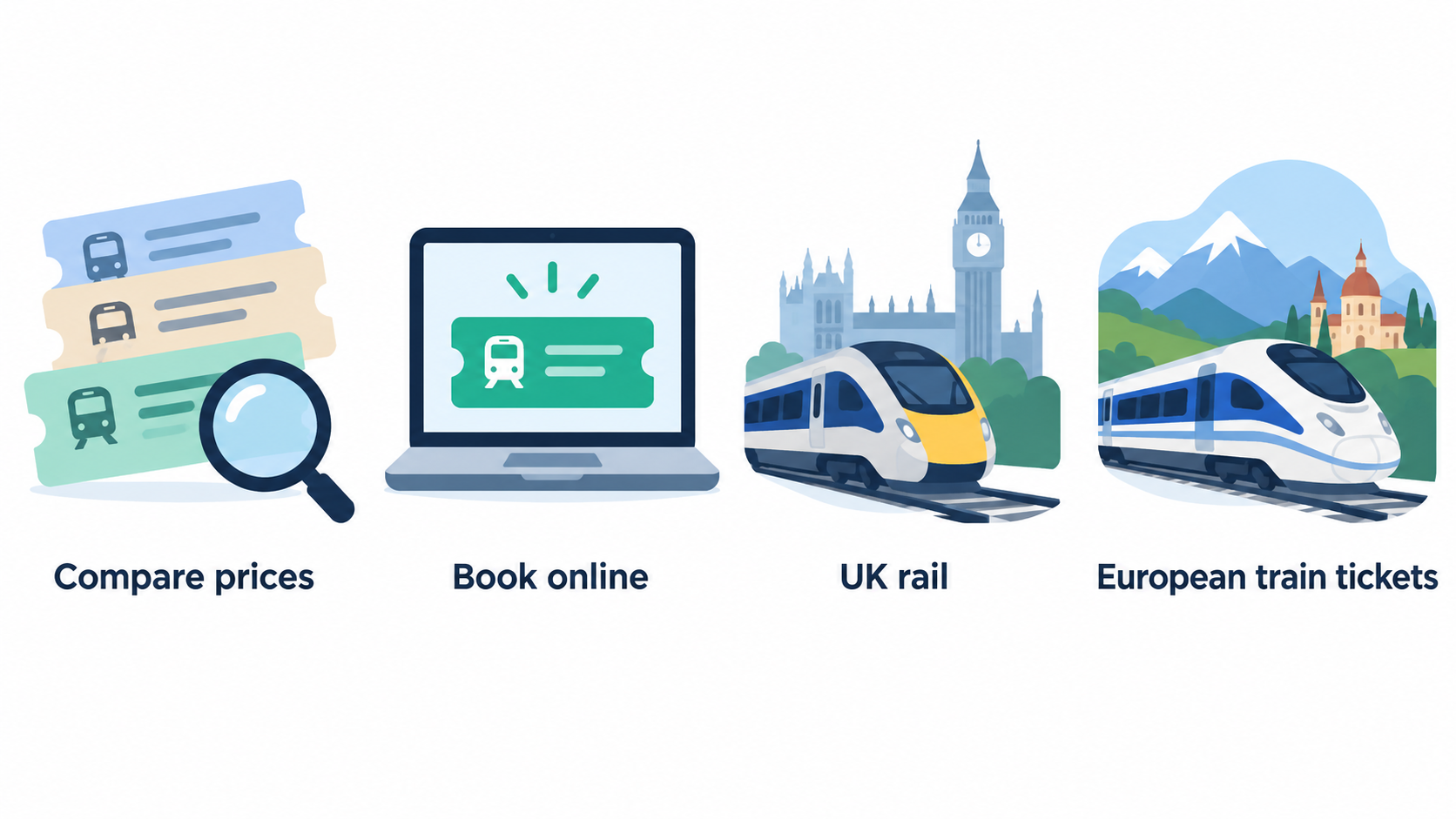
These four are different kinds of channel, so they are not strictly like-for-like competitors. Each does a different job.
Trainline describes itself as a place to compare prices and book online. Its pages cover UK rail as well as European train tickets, and its navigation lists operators such as Eurostar, Trenitalia, Deutsche Bahn, SNCF and Renfe. Think of it as a rail and European comparison retailer.
Split My Fare describes itself as a split-ticketing service. It says it searches all its fares, including advance fares and splits, to find savings on domestic train tickets. It is a specialist tool rather than a general travel shop.
National Express is the coach operator in this set. Its booking form offers single, return and open return journeys, with coachcards available for eligible passengers.
Eurostar sells its own tickets directly. Its fares page describes three classes of service: Standard, Plus and Premier. Booking here means you deal with the operator and its own conditions.
If you are planning a cross-Channel trip, Seat61's "How to buy European train tickets" guide is a useful independent starting point alongside the operator's own pages.
How This Guide Was Built and What It Cannot Tell You
AI-generated illustration — not a retailer product photo.
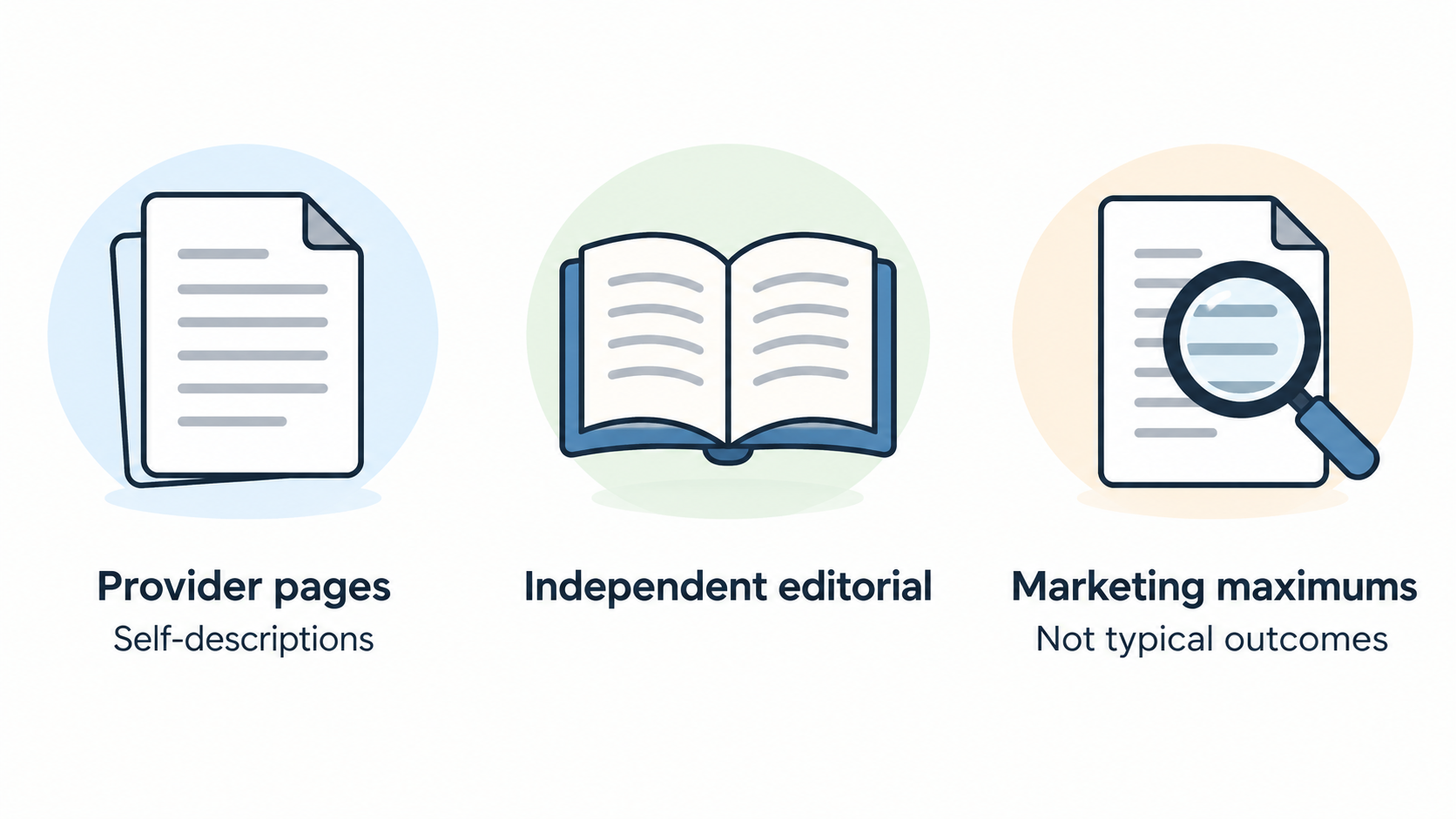
The evidence comes from two kinds of source. The first is each provider's own published pages: Trainline's cheap tickets page, Split My Fare's home page, National Express's ticket help and booking page, and Eurostar's fares and fees page. The second is independent editorial material: Seat61's beginner's guide to train travel in Britain, and Railfuture's explanation of ticket types.
That has consequences you should know about:
- Provider pages are self-descriptions. Figures such as "save up to 61%" (Trainline) and "save up to 90%" (Split My Fare) are marketing maximums, not typical outcomes.
- No hands-on testing. We did not run live price comparisons, make bookings or test customer service.
- Prices and terms change. Confirm fares, fees and conditions at checkout before you pay.
- Trainline's booking fees are not covered. The sources we used do not set out Trainline's fee levels, so we make no fee claim for it.
The Shortlist at a Glance
The table summarises what each provider publishes. It is not a ranking, and the evidence behind each entry is labelled so you can judge how much weight to give it.
| Trainline | Split My Fare | National Express | Eurostar direct | |
|---|---|---|---|---|
| Best for | Comparing UK and European rail in one place | Domestic rail journeys where splitting could help | Coach journeys | London to continental trips |
| Headline published feature | Says "save up to 61%" and that Advance fares are often cheaper than buying on the day | Says "save up to 90%" and no booking or card fees | Single, return and open return; return must be within 3 months of outward trip | Fee-free changes up to one hour before departure on Standard and Plus |
| Main caution | Fee levels not covered in our sources; check at checkout | Savings figure is a best case; train must stop at every ticketed point | Child and infant passenger rules apply, including limits on unaccompanied children | Refunds limited; no refund of the difference if an exchange is cheaper |
| Evidence strength | Provider's own page, plus independent advice from Railfuture on Advance tickets | Provider's own page only | Provider's own booking page only | Provider's own published conditions (primary source) |
Both Trainline and National Express let you add discount cards when you search: Trainline offers an "Add railcards" option and National Express offers an "Add Coachcards" option. If you hold either, enter it before comparing prices.
Where Each Option Is Strongest
Trainline: breadth. Its navigation covers UK rail plus European routes and operators including Eurostar, Trenitalia, Deutsche Bahn, SNCF and Renfe. It says that booking early is one of the most effective ways to save money, which matches independent advice from Railfuture that Advance tickets are usually, though not always, cheaper. If you want one place to compare UK and European options, that breadth is its main published strength.
Split My Fare: a narrow job done on purpose. It says that splitting means buying two or more tickets instead of one, while you stay on the same train with no extra changes. It also says it charges no booking or card fees. On legality, its own page says splitting is legal, with the only condition being that the train must stop at the points where your tickets change. These are the provider's claims, not independently verified here. Because savings depend on how fares are priced for your particular route, splitting is most relevant on domestic journeys.
National Express: a direct route to coach fares. Its booking form lets you choose single, return or open return, and offers coachcards. It also states its return window clearly: a return must be within 3 months of your outward travel.
Eurostar direct: clear conditions. Its fares page sets out exchange and refund rules in plain terms and describes three service classes. For a cross-Channel trip where you may need to change plans, having those conditions from the operator itself is the key strength.
Limitations and Trade-offs to Check Before You Pay
Advance tickets are inflexible. Railfuture notes that Advance tickets are valid only for a specific train. If you miss it, the ticket is valueless and cannot be part-exchanged. If an Advance fare is very cheap, Railfuture suggests a second ticket for a slightly later train may be worth buying as a hedge.
Split tickets come with a condition. Split My Fare says the train must stop at the points where your tickets change. Check this before you buy.
Headline savings are best cases. "Up to 61%" and "up to 90%" describe the maximum, not what you should expect on your trip.
Eurostar exchanges and refunds have traps. On Standard and Plus:
- If the new ticket costs more than the original, you pay the difference. If it costs less, you do not get the difference back.
- Tickets exchanged less than seven days before departure to a later date become non-refundable.
- Tickets are refundable for a fee seven days or more before departure, and non-refundable less than seven days before travel.
- If you claim a refund on one leg of a return, the refund takes account of any return discount you received when you bought it.
National Express has age rules. Children under 14 cannot travel without a responsible person aged 16 or over throughout the journey. Children aged 14 to 15 may travel unaccompanied from 5am, arriving at their destination no later than 10pm. Unaccompanied children may be asked for proof of age or a signed consent.
Evidence gaps. The sources do not provide Trainline fee levels, so check fees at checkout. For refunds and delay compensation on UK rail, check the terms of your specific ticket.
Ticket Types and Timing in Plain English
Railfuture's advice is that the right ticket depends on when you travel, how often, and whether you can commit to specific times.
- Season ticket: suits similar journeys every day.
- Rover or ranger: may suit multiple journeys within an area.
- Advance: may be the best choice for a specific journey where you can commit to travel times.
- Anytime: needed if you must travel in the peak period. It can be bought as a single or a return.
- Off-Peak: suits other times of day, and is usually available only as a return.
Walk-on tickets, including Anytime and Off-Peak, can definitely be bought on the day of travel. All ticket types can be bought in advance. Most are available in standard or first class, though there are exceptions.
On timing, Trainline says train fares usually increase as the travel date approaches and that booking early is one of the most effective ways to save. It adds that Advance tickets are often cheaper than buying on the day. That is a sensible rule of thumb whichever site you use. The trade-off is the Advance restriction above: cheaper, but tied to one train.
Alternatives and When to Book Direct or Use Independent Guides
Book direct with the operator. Eurostar shows the benefit: booking with the operator gives you access to its own exchange and refund conditions as published on its site. For coach travel, the operator's site is the natural channel, as in National Express's own ticket search.
Use a comparison or split-ticket site for domestic rail. These add most value where fares can differ depending on how tickets are combined. On a single-operator coach route, or a Eurostar-only trip where you want the operator's exact conditions, going direct may be simpler.
Use independent guides for planning. Seat61 describes itself as a beginner's guide to train travel in Britain and also covers Europe, including how to buy European train tickets and Eurostar from London. It is useful for planning routes and understanding how tickets are sold before you pick a retailer.
Other retailers exist. We have not assessed them, because the evidence set does not cover them. Absence from this guide does not mean a retailer is better or worse.
Frequently Asked Questions
Is split ticketing legal and will I stay on the same train?
Split My Fare says split ticketing is legal, with the only condition being that your train must stop at the points where your tickets change. It also says you travel on the same train with no changes to your normal journey. These are the provider's own statements, so check your specific train's stops before buying.
Do these booking sites charge booking fees?
Split My Fare says it charges no booking or card fees. The sources we used do not set out Trainline's fee levels, and they do not cover National Express booking fees, so check at checkout. Eurostar publishes fees for certain refunds and says Standard and Plus exchanges carry no fee until one hour before departure.
Can I change or get a refund on a Eurostar ticket?
On Standard and Plus, you can change the date or time with no fee until one hour before departure, but you cannot change your destination. If the new ticket costs more you pay the difference, and if it costs less you get nothing back. Refunds are available for a fee seven days or more before departure, but not within seven days. An exchange to a later date made less than seven days before departure makes the ticket non-refundable.
Is an Advance ticket always cheaper than buying on the day?
No. Railfuture says Advance tickets are usually, but not always, cheaper, and are valid only for a specific train. Trainline says they are often cheaper than buying on the day. Compare before you commit.
Which site is best for coach travel versus train travel?
For coach travel, National Express is the coach-specific channel in this set. For UK and European train travel, Trainline offers broad comparison, Split My Fare focuses on split tickets for domestic rail, and Eurostar direct covers Eurostar services.
Sources
- Official source
- Official source
- Official source
- Official source
- Independent guidance
- Independent guidance
Related reading
- Trainline vs Split My Fare: which is the better fit for UK split-ticket bookings
- Trainline review: booking fees, split tickets, railcards and alternatives
- How to choose a UK train ticket booking site: fees, split tickets and refunds
- How to identify genuine train ticket deals: fees, split tickets and railcard claims
Editorial information: About our editorial team · Read our editorial policy · Read our affiliate disclosure.