
AI-generated illustration — not a retailer product photo.
Why UK Train Booking Sites Are Not All the Same
AI-generated illustration — not a retailer product photo.
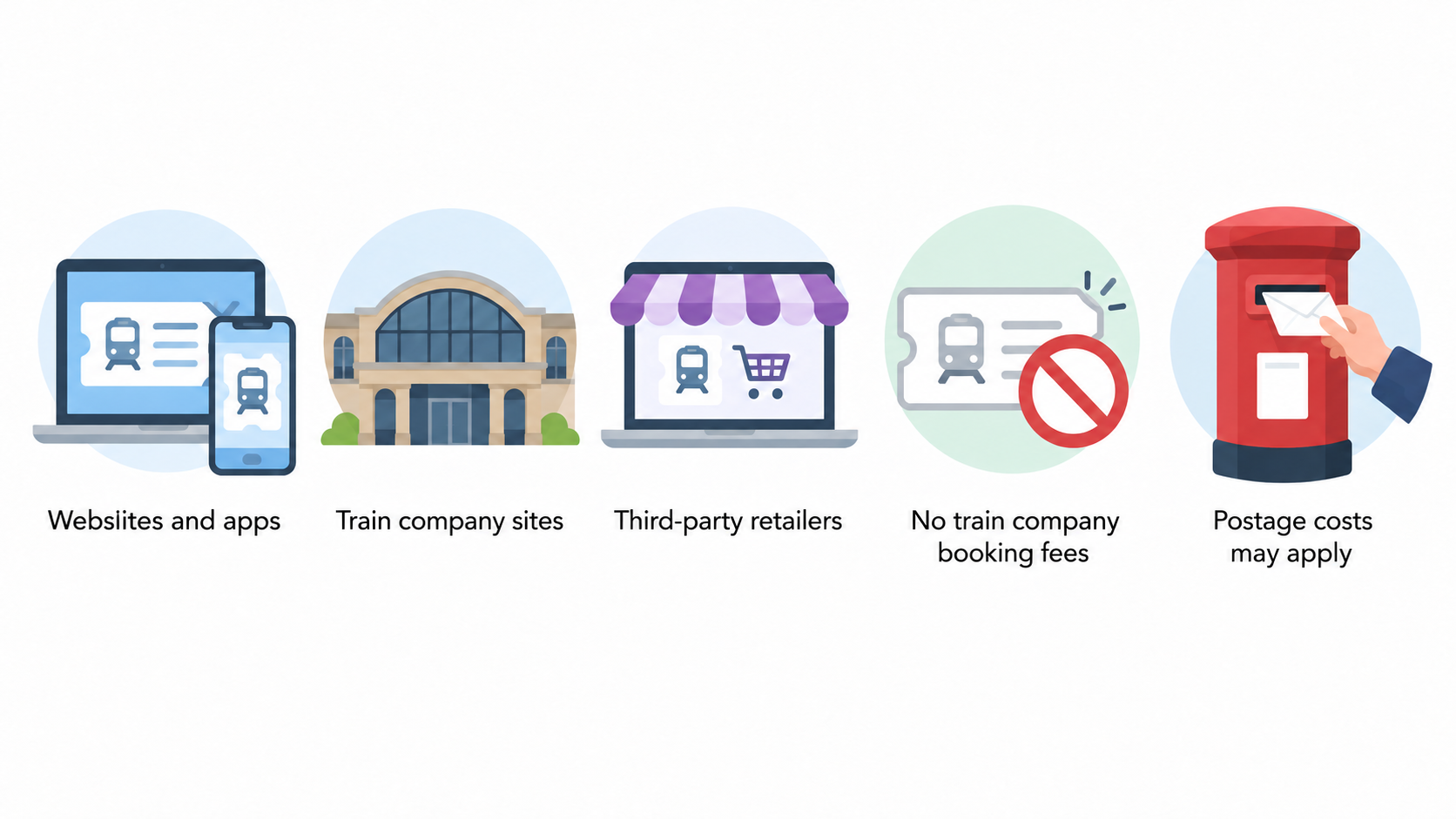
Buying a UK rail ticket used to mean a handful of obvious choices. Now, as the rail regulator ORR put it in December 2023, "consumers can now purchase rail tickets from a wide variety of websites and apps". Those sites are not interchangeable, and the differences show up in what you pay and what you can get back.
The most important divide is between train company sites and third-party retailers. According to ORR, train companies are not permitted to charge ticket booking fees, although they can charge certain fees such as postage costs for ticket delivery. Many third-party retailers, by contrast, do charge booking fees. That does not make a retailer a poor choice, because some offer features a single train company's site may not. It means the decision is a trade-off, and the trade-off is worth checking before you pay.
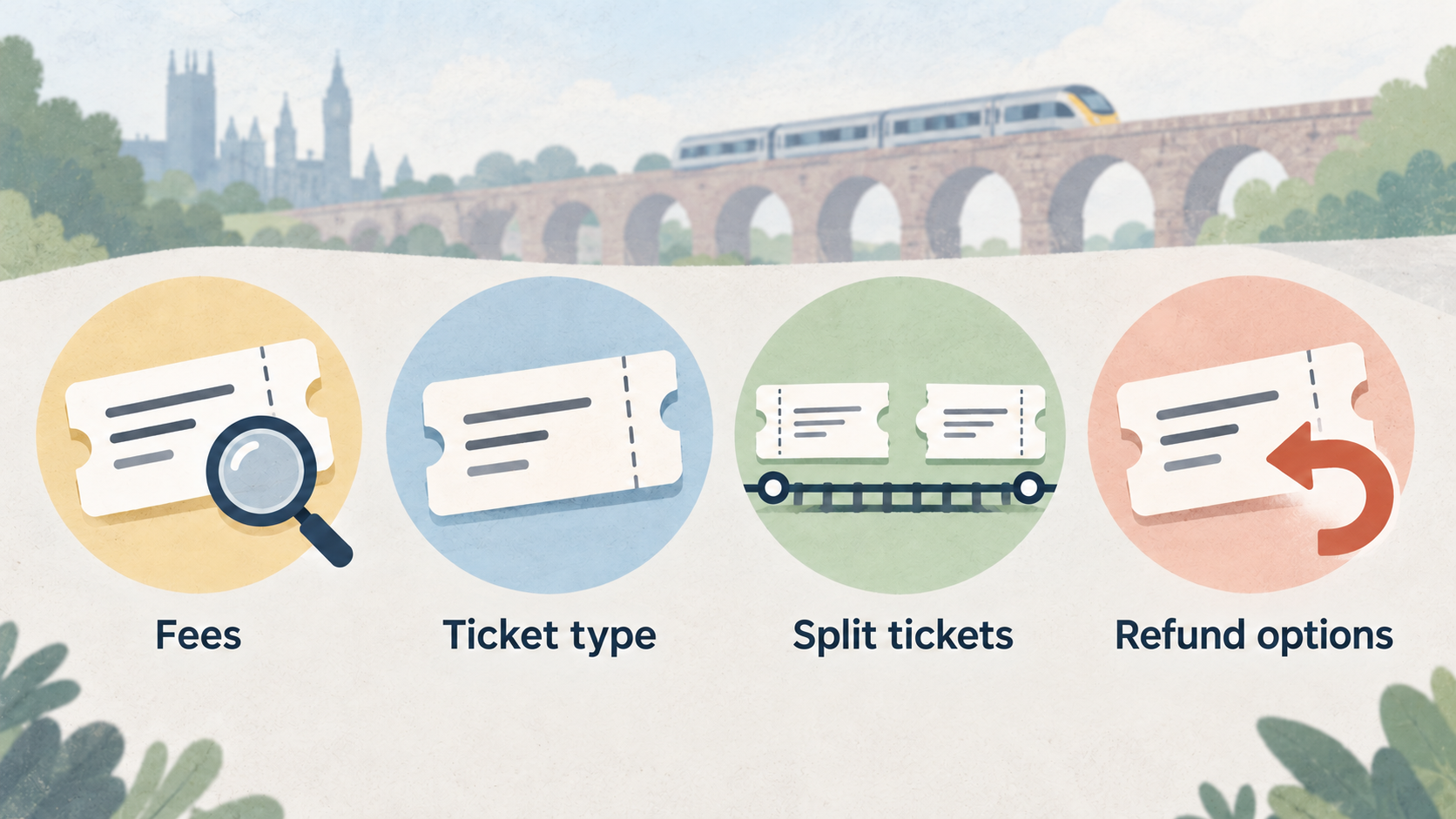
This guide compares booking sites on four points:
- Fees: whether a booking or other fee applies, and how clearly it is shown.
- Split-ticket handling: whether the site sells tickets for separate parts of a journey, and how it treats changes.
- Refund routes: who you contact, and by when.
- Ticket delivery: how your ticket reaches you, and whether a charge applies.
Ticket type also matters on every site, because an Advance, Off-Peak or Anytime ticket carries its own flexibility whichever retailer you use. Where the published sources do not fix a single answer, this guide says "varies by retailer" rather than guess.
What Booking Sites Do Well
AI-generated illustration — not a retailer product photo.
Third-party retailers and specialist split-ticket sites exist because they offer something beyond a single operator's own site. The descriptions below come from the retailers' published pages, so they show what is offered, not how well it performs in independent testing.
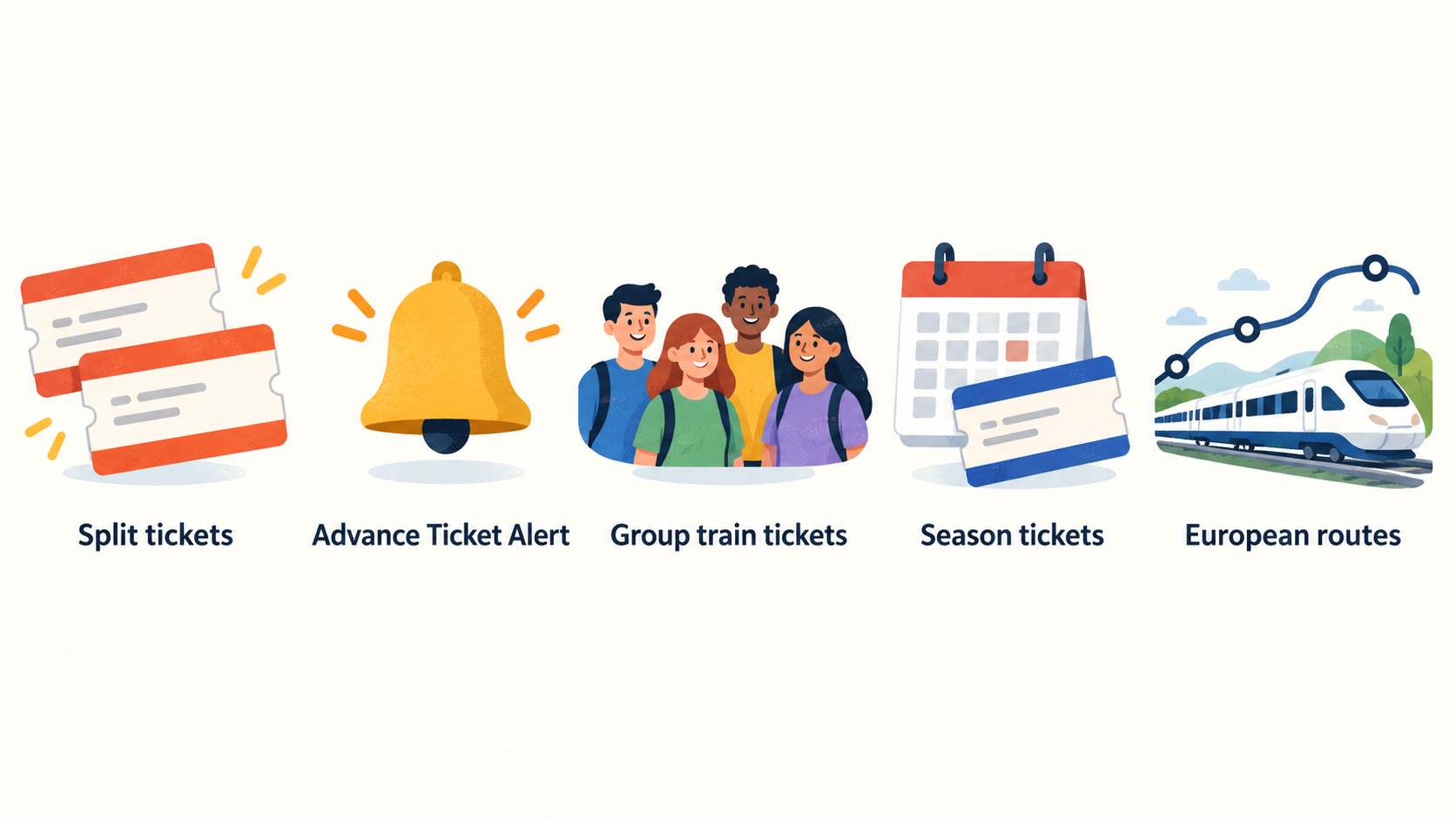
Trainline's published site navigation lists a range of features: split tickets, Advance Ticket Alert, group train tickets, season tickets and digital season tickets, and Flexi Season tickets. It also lists European routes and operators, including Eurostar, Trenitalia, Deutsche Bahn, SNCF and Renfe. For anyone combining a UK leg with a continental trip, a single retailer covering both can simplify planning.
Split My Fare is built around a narrower idea. Its help page describes splitting a fare as buying tickets for two parts of a journey instead of one ticket for the whole journey, which it says can make the fare cheaper.
These are the retailers' own descriptions. A feature appearing in a menu or help page does not tell you the price you will pay for a given journey, or whether the extra convenience outweighs any booking fee. The next section covers the cost side.
Where Booking Sites Can Cost You More
The main cost risk is fees that become clear only late in the booking. In December 2023, ORR reviewed the websites and apps of 19 third-party ticket retailers and 21 train companies. It identified concerns with "drip pricing", which in plain terms means extra costs that surface step by step instead of up front. ORR asked retailers to give readily available, transparent and accurate information about fees that customers can read before starting the booking process. It wrote to seven third-party retailers about its concerns.
The review focused on four types of fee, including booking fees, which ORR says are charged by many third-party retailers, and finder's fees. Train companies were part of the review but are not permitted to charge booking fees, though they can charge certain fees such as postage for ticket delivery.
Practical steps that follow from this:
- Compare the total at checkout across sites, not the headline fare shown in search results.
- Look for fee information before you begin booking, since that is where ORR said it should be available.
- Check the delivery option, because postage costs can apply when a ticket is posted.
One caution on dates: these findings date from 2023 and do not describe any one retailer's current practice. Treat them as a reason to check the total, not as a verdict on any named site.
Ticket Types to Understand Before You Book
AI-generated generic editorial illustration — not a retailer product photo and does not depict the reviewed product or service. Help readers match their travel certainty to a ticket type, since ticket type sets flexibility and refund options whichever retailer is used.
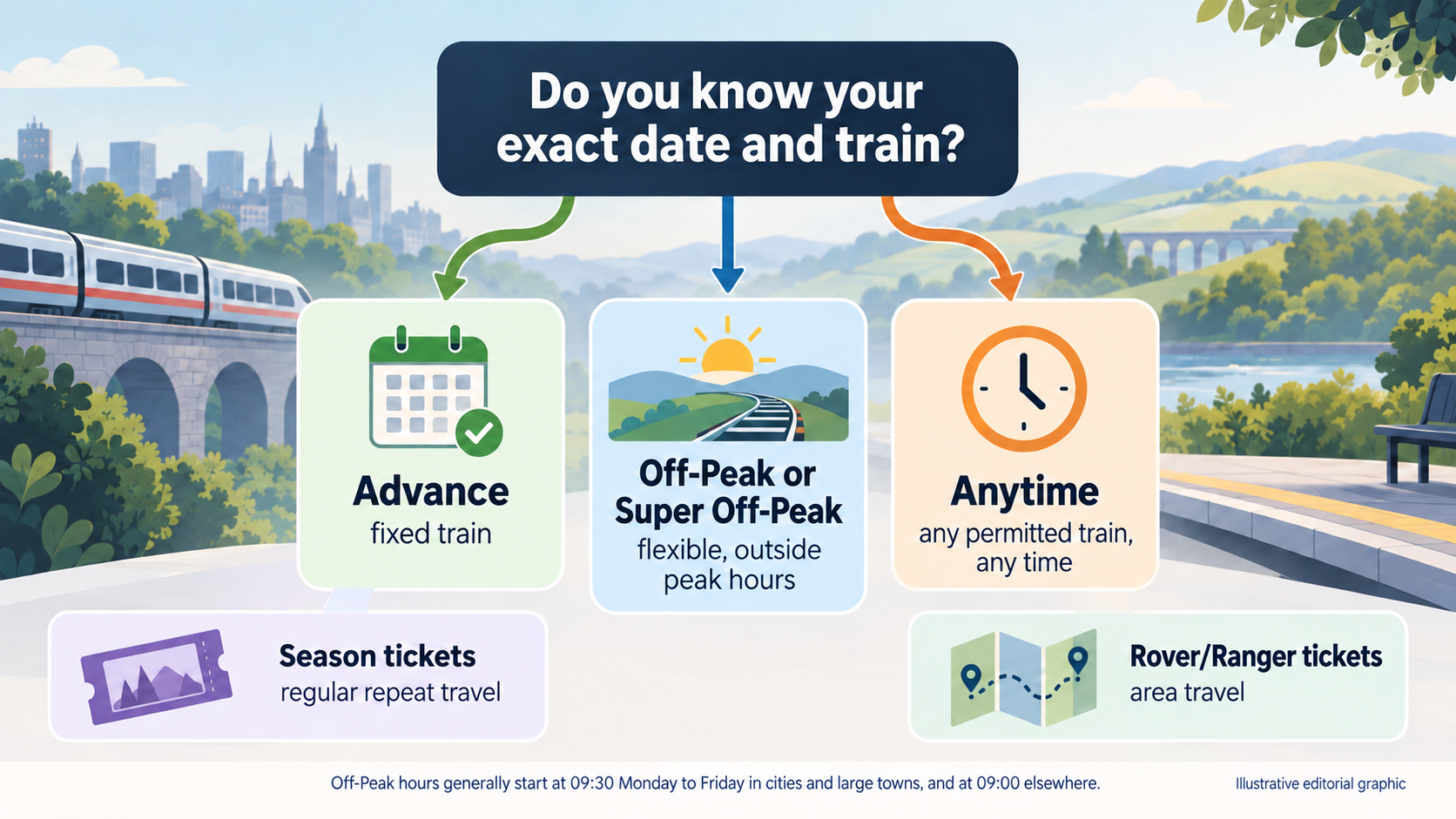
Ticket type sets how flexible your journey is, and it shapes your refund options whichever retailer you use. National Rail's guidance starts with a simple question: if you know the date and time you want to travel, an Advance ticket will be suitable. For more flexibility, Off-Peak, Super Off-Peak and Anytime tickets suit better, as you are not limited to a specific date or train.
- Advance: valid only on the date and train specified. You can usually buy one up to 12 weeks ahead, and on many routes they remain available until the day of travel, sometimes up to 10 minutes before departure.
- Off-Peak and Super Off-Peak: can be bought at any time and used on permitted trains during off-peak hours. If one is available for your journey, journey planners will offer it.
- Anytime: can be bought at any time and used on any permitted train, at any time.
- Season and Flexi Season: unlimited travel between two stations, normally available weekly, monthly or yearly.
- Rover and Ranger: listed by National Rail as separate ticket categories. Check its pages for the details.
On timing, Off-Peak hours generally begin at 09:30 Monday to Friday in cities and large towns, and at 09:00 everywhere else. If your train is scheduled to depart after that time, you can travel with an Off-Peak ticket. Weekends and bank holidays are off-peak all day.
How Split Tickets Work and What to Check
Splitting a fare means buying tickets for separate parts of a journey rather than one ticket for the whole route. Trainline lists split tickets as a product, and Split My Fare is built around the approach.
The trade-off is complexity. With several tickets in one booking, a change or refund can involve more than one ticket, so check how the retailer handles this before you rely on it. Split My Fare states that if you are travelling with fixed or Advance tickets, you can only change the date and time of departure. That is a useful reminder that a split made of Advance tickets is less flexible than one made of flexible tickets.
Before buying a split, it is sensible to:
- Confirm that your train stops at each point where the journey is split.
- Read the retailer's terms of travel for split tickets.
- Check what happens to each ticket if you change your plans.
- Compare the total of the split against the single-ticket price, including any booking fee.
Whether a split saves money depends on the route, the time and the ticket type, so the only reliable test is to compare the final price for your own journey.
Refunds, Changes and Delay Repay Routes
The retailer's terms set the route and time limits for changes and refunds, so it pays to read them before buying. Trainline's terms, last updated on 15 April 2026, cover changes, refunds, cancellations and payment methods, and include market-specific sections for French and American customers.
Split My Fare's help page gives a concrete example of how one retailer handles things:
- Amendments: all tickets are amendable, but fixed or Advance tickets can only have the date and time of departure changed.
- Booking mistakes: it states you can claim a refund on the total cost within 1 hour of purchase for a future date, or within 15 minutes for same-day travel.
- Cancellations: flexible tickets are refundable. Fixed or Advance tickets are refundable only for medical reasons or if your journey was cancelled. It says it can process a refund if the tickets are unused; otherwise you contact the train operator you travelled with.
- Delay Repay: compensation is claimed through the train operator, not the retailer. The amount varies with the length of the delay and the ticket type, and Split My Fare states claims must be submitted within 28 days of the delayed journey.
These are one retailer's statements, not a rule for every site. Refund rules, deadlines and any admin fees vary by retailer and ticket type, so read the current terms of whichever site you use.
Which Booking Approach Fits Your Journey
This section offers fit guidance, not a ranking, and no site has been tested for this guide.
- Fixed plans on a single operator: compare the train company's own site, where booking fees are not permitted, with a retailer's total price. Remember that postage can still apply if you want a posted ticket.
- Long cross-country routes: split tickets may be worth comparing, because splitting is aimed at journeys that can be bought as separate parts.
- UK and European trips combined: a retailer that lists both UK operators and European operators, such as Eurostar, Deutsche Bahn or SNCF, may suit you if you value one place to book.
- Flexible commuters: compare season tickets, Flexi Season tickets and Off-Peak options, since National Rail describes each as suiting a different pattern of travel.
- Flexible leisure trips: Off-Peak, Super Off-Peak and Anytime tickets avoid being tied to one train, which matters if your plans might shift.
Whichever description sounds like you, the next section turns the comparison into checks you can run in a few minutes.
A Practical Checklist for Choosing a Retailer
Run through these before you pay, on any booking site:
- Fees: is a booking fee shown before you start booking, and what is the total at checkout?
- Direct price: is the same price available on the train company's own site, where booking fees are not permitted?
- Split tickets: if the booking contains several tickets, how are changes and refunds handled across them?
- Refund and change window: what are the time limits, and does the retailer or the train operator handle your claim?
- Delivery: is the ticket an e-ticket or collected from a station, or posted? Train companies may charge postage, so confirm any charge.
- Ticket type: which restrictions apply, such as a specific date and train for Advance, or off-peak hours for Off-Peak?
If a site cannot answer these clearly before payment, that is itself useful information. Once you have the answers, compare the final totals and pick the option whose price and flexibility match your plans.
How This Guide Was Compiled
This guide draws on four published sources: Trainline's terms and conditions (last updated 15 April 2026), National Rail's ticket information, Split My Fare's help page and ORR's December 2023 press release on ticket retailer fees.
It is editorial guidance built from published terms and official or regulatory information. It does not rest on personal or independent testing of any booking site. The sources are a sample of retailers, not a complete survey of the market, so absence from this guide says nothing about a retailer. Retailer terms change, and the ORR findings are from 2023, so confirm current terms and fees before you buy.
Frequently Asked Questions
Do train companies charge booking fees?
No. ORR states that train companies are not permitted to charge ticket booking fees. They can charge certain fees, such as postage costs for ticket delivery. Many third-party retailers do charge booking fees.
Are split tickets safe and legitimate to use?
Trainline lists split tickets as a product and Split My Fare is built around the approach, which means buying tickets for two parts of a journey instead of one for the whole journey. The sources reviewed here do not set out every rule, so confirm that your train stops at the split points and read the retailer's terms of travel before relying on a split.
Can I get a refund on an Advance ticket?
It depends on the retailer's terms. Split My Fare states that fixed or Advance tickets are refundable only for medical reasons or if your journey was cancelled, and can only have the date and time of departure changed. Other retailers' rules may differ, so read the terms of the site you book with.
Who do I claim Delay Repay from if I booked through a retailer?
Split My Fare states that Delay Repay is claimed through the train operator, not the retailer, and that claims must be made within 28 days of the delayed journey. The compensation varies with the length of the delay and the ticket type.
Is it cheaper to book directly with the train company?
Not necessarily in every case. Train companies cannot charge booking fees, which gives their sites a built-in advantage on that one cost, but a retailer might offer a split ticket or another option that changes the total. Compare the final price at checkout on each site for your journey.
Sources
Related reading
- Trainline vs Split My Fare: which is the better fit for UK split-ticket bookings
- Trainline review: booking fees, split tickets, railcards and alternatives
- Split My Fare review: who it suits and who should skip it
- UK rail ticket types explained: Advance, Off-Peak, Anytime and railcards
Editorial information: About our editorial team · Read our editorial policy · Read our affiliate disclosure.