
AI-generated illustration — not a retailer product photo.
Our Verdict on Trainline
AI-generated illustration — not a retailer product photo.
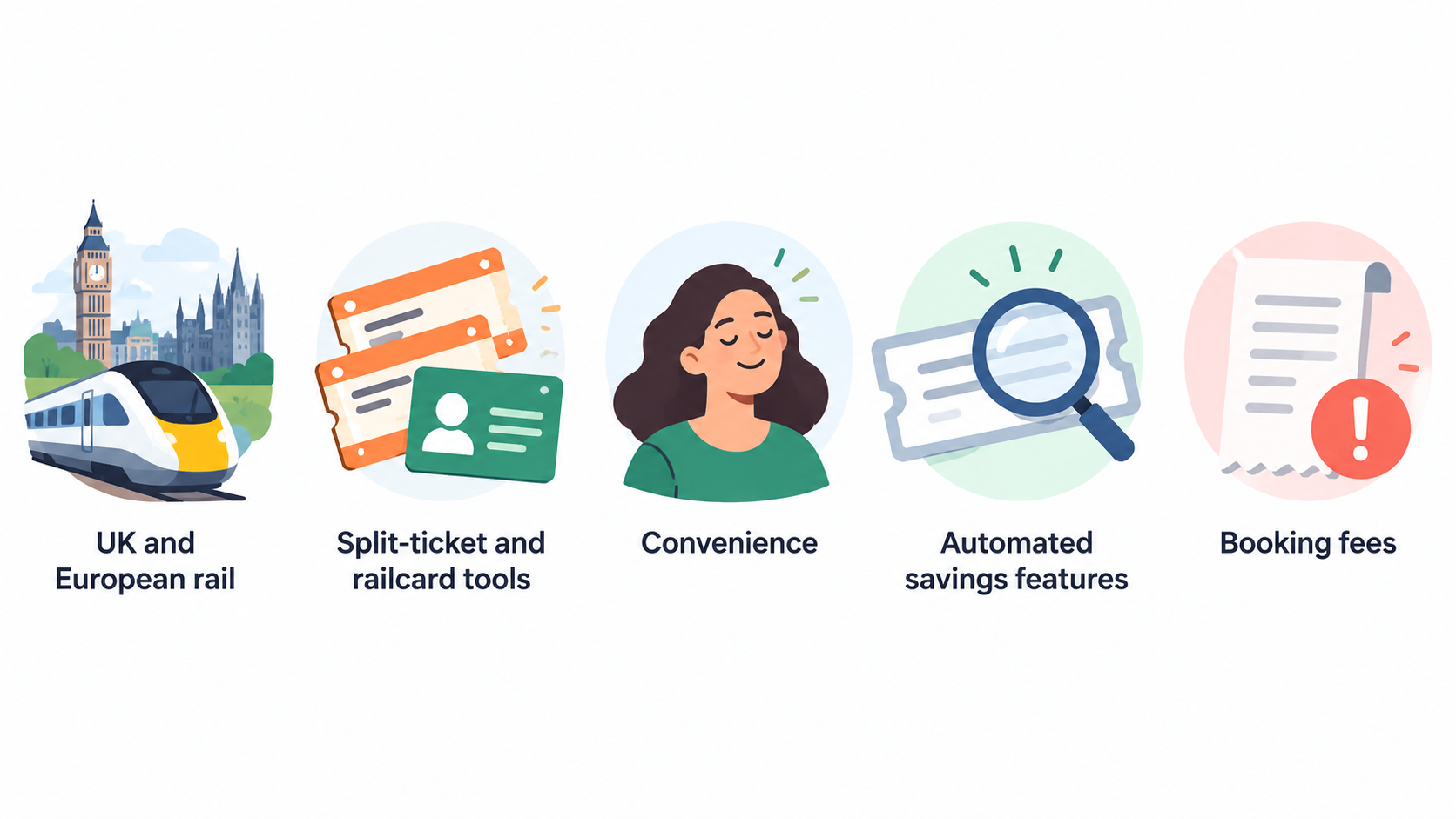
Trainline is a sound option if you want one app for UK and European rail, particularly if you like having split-ticket and railcard tools built in. Convenience and automated savings features are the main draw. You avoid juggling a separate operator site in each country, and Trainline promotes tools that hunt for cheaper fares on your behalf.
The main trade-off is fees. Many third-party ticket retailers charge booking fees, while train companies selling directly are not permitted to. Whether Trainline's convenience is worth paying for therefore depends on the final price on your screen, not on the headline savings figures in its marketing.
The habit that protects you most is simple: before you pay, compare the final basket total with the price on the train operator's own site.
This is editorial guidance, not a record of personal testing. Our verdict rests on Trainline's published pages and terms, a regulator statement and independent coverage. Fares and fees change, so check live prices at the point of booking.
What Trainline Is and How We Assessed It
AI-generated illustration — not a retailer product photo.
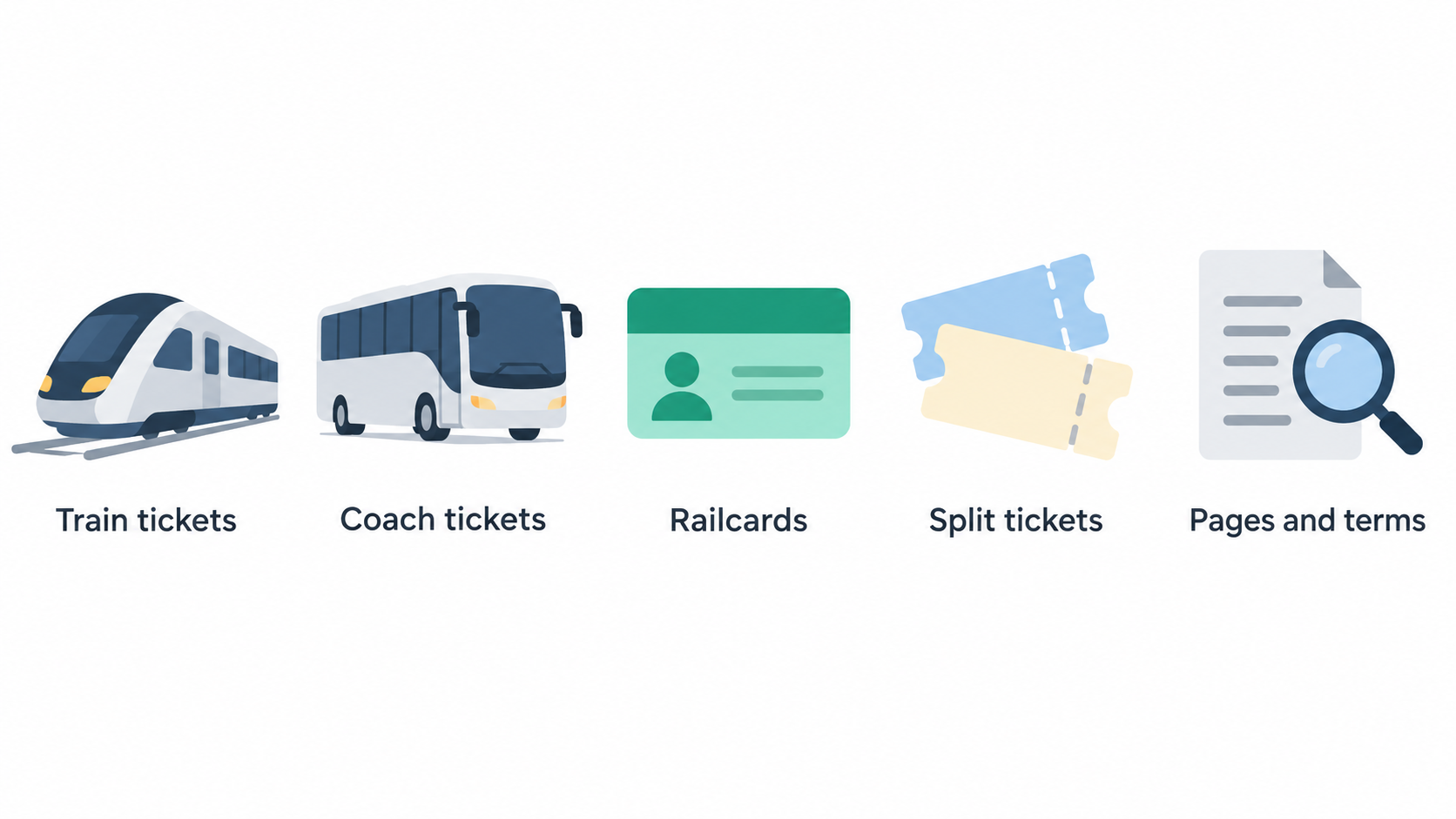
Trainline sells UK and European train tickets, and its navigation also lists coach tickets. Its site and app cover railcards, season tickets, split tickets and group train tickets. It presents itself as a place to compare prices and book online, and it lists operators such as Eurostar, Trenitalia, Deutsche Bahn, SNCF, Renfe and OBB under European travel.
To judge what it offers, we relied on three kinds of source:
- Trainline's own pages and terms, for what the company says it offers and how bookings, changes and refunds are governed.
- Independent editorial coverage, for outside views on how the app works in practice, including its split-ticket feature and its UK and Europe coverage.
- Regulator commentary, from the Office of Rail and Road (ORR), for context on booking fees and how retailers present them.
There are limits. We have not tested the app, so we cannot speak to its reliability, its customer service or the exact fees it charges today. Treat what follows as a guide to the questions worth asking, not a verdict on every journey.
Where Trainline Does Well
AI-generated illustration — not a retailer product photo.
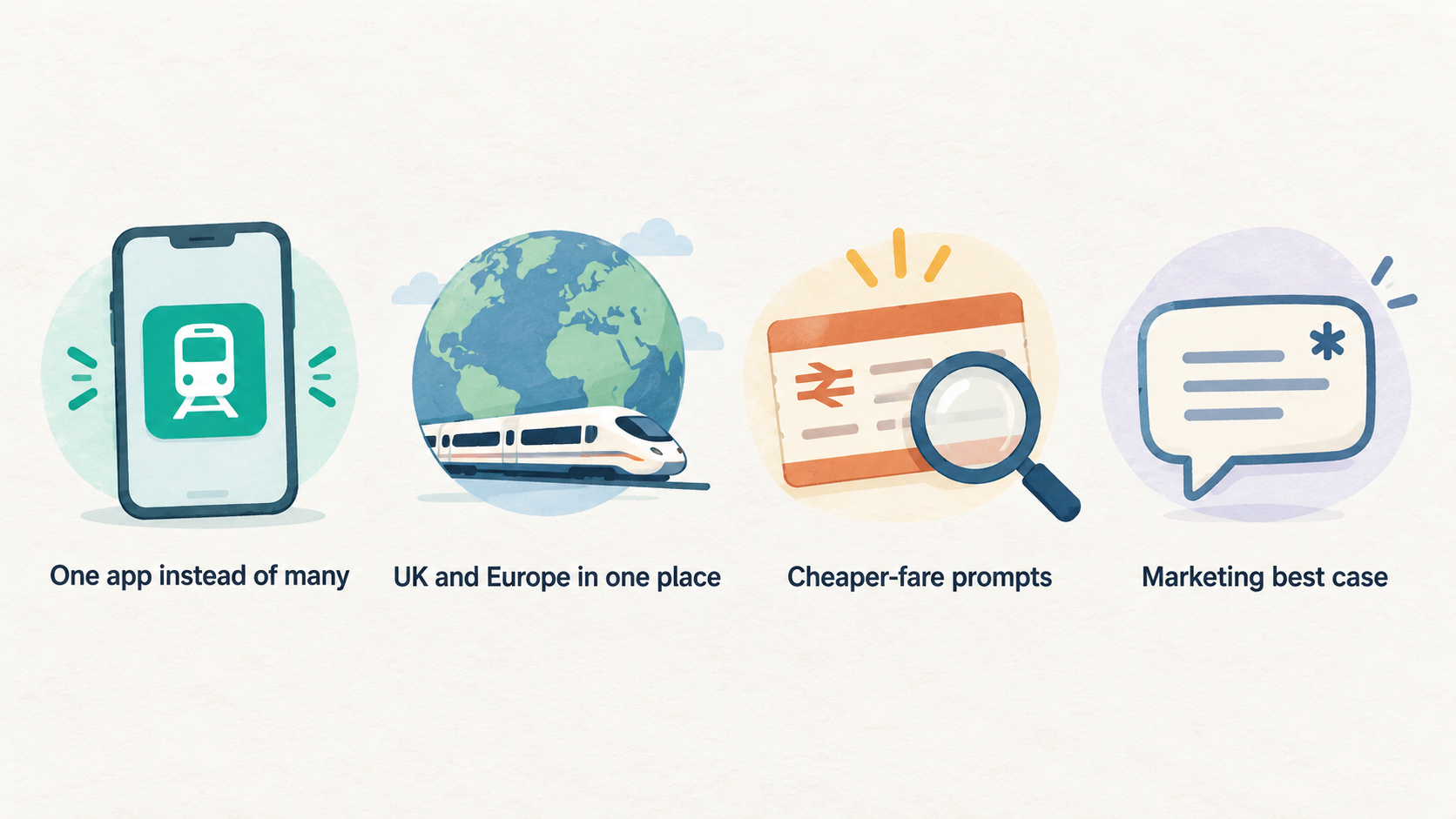
One app instead of many. Booking European rail has traditionally meant a different operator, and often a different website, in each country. Independent review coverage praises Trainline for letting travellers book across the UK and Europe in one place. For anyone linking several countries in a single trip, that is a real saving in time and effort.
Cheaper-fare prompts. Trainline's cheap-tickets page promotes finding lower fares and Advance tickets, and carries a headline claim of savings of up to 61%. That figure is a marketing best case. It shows what the company is aiming at, not what a typical traveller will save. The site also lists tools such as Advance Ticket Alert, which is built around the idea of buying early.
Split tickets and railcards in the same place. Trainline lists split tickets and digital railcards alongside ordinary bookings. Its SplitSave feature automates split ticketing, which means you do not have to study fare tables yourself (more on this below). Its railcard tool also guides you towards a suitable card.
It is worth being precise about what these strengths are. They are convenience features. Nothing in the evidence suggests Trainline guarantees the lowest price on any given journey.
How Split Tickets and SplitSave Work
Split ticketing means buying several tickets that together cover one journey. Because of quirks in UK fare structures, the combined price can sometimes be lower than a single through fare. An independent guide gives a London to Manchester example: a direct ticket might cost more than one ticket to Stoke-on-Trent plus a second from Stoke-on-Trent to Manchester, even though you sit on the same train throughout.
SplitSave is described as Trainline's branded, automated version of this. Instead of you checking route maps and fare tables, the system looks for combinations. According to that independent coverage, you stay on the same train, and in the same seat, while holding separate tickets for each segment. Nothing about the physical journey changes.
There are catches worth knowing:
- Savings are not guaranteed. They depend on fare-structure quirks, which differ from route to route. Some journeys will offer no saving at all.
- Disruption can be harder to reason about. With several tickets for one trip, it is worth checking the ticket conditions and what applies if your train is delayed.
- Railcards need checking. The evidence we reviewed does not confirm how railcard discounts apply to split fares, so confirm that your discount is applied before you pay.
If you are tempted by split tickets, read the conditions shown at checkout rather than assuming they behave like a single through ticket.
Railcards, Advance Tickets and Saving Money
Book early where you can. Trainline's own guidance says train fares usually increase as the travel date approaches, and that booking early is one of the most effective ways to save. Advance tickets are often cheaper than buying on the day. This is general rail advice, and it holds whichever site you use.
Choosing a digital railcard. Trainline lists digital versions of the 16-17 Saver, 16-25, 26-30, Senior, Network, Two Together and Family & Friends railcards. Its railcard tool asks three things: your age, who you usually travel with (alone, as a couple or as a family), and whether you travel within London and the South East. Regional railcards are described as saving a third on journeys between two stations within the region.
Renewing. Railcards can be renewed by logging in to your Trainline account and following the steps, which is handy if you already book there.
Does a railcard pay off? That depends on how often you travel. Compare the cost of the card with the discount you would realistically receive over a year. A card that suits a weekly commuter may not suit someone taking two trips annually. The tool's questions are a useful starting point, but the sums are yours to do.
Booking Fees and What the Regulator Says
The clearest outside evidence on fees comes from the ORR. In a statement dated 11 December 2023, the regulator said it had reviewed the websites and apps of 19 third-party ticket retailers, and also looked at 21 train companies. The key distinction it drew: booking fees are charged by many third-party retailers, but train companies are not permitted to charge them. Train companies can charge certain other fees, such as postage costs for ticket delivery.
The regulator's concern was "drip pricing", where fees appear late in the booking process. It wanted customers to have clear, accurate fee information that they can read before starting to book. It wrote to seven retailers asking how they would address its findings.
Please read that carefully. The material we reviewed does not say which seven retailers were contacted, so no conclusion about Trainline specifically should be drawn from it. Nor does it give Trainline's fee levels.
Two practical points follow. The statement is from December 2023, so fee practices may have changed. And the safest response is the same either way: put your journey into Trainline and the operator's own site, then compare the final basket total.
Limitations and Things to Check Before You Book
Fees. As above, third-party retailers can charge booking fees where operators selling direct cannot. We have not tested Trainline's current fees, so check the final total before paying.
Terms and refunds. Trainline's Terms and Conditions (last updated 15 April 2026) cover booking, changes, refunds, cancellations and payment methods. They also distinguish Trainline's own terms from the separate terms of operators or third parties. In practice, that means your rights on changes and refunds may depend on the ticket type and the train company as well as on Trainline. Read the conditions for your specific ticket.
Regional sections. The terms include region-specific sections, among them an agreement to mandatory arbitration for US customers. UK travellers are unlikely to be affected, but it shows the terms differ by market.
Marketing figures. Savings claims such as "up to 61%" are best-case figures.
Split tickets in disruption. Several tickets for one journey can be harder to reason about if things go wrong, so check the conditions first.
What we could not assess. Because we did not test the service, we cannot comment on app reliability, customer-service quality or current fee amounts. If any of these matter to you, check recent user feedback and live prices before relying on this review.
Trainline Alternatives and When to Use Them
There are three main routes to a ticket, and no evidence supports declaring one the best overall.
Book direct with the train operator. UK train companies are not permitted to charge ticket booking fees, so this route avoids that cost. The compromise is that you deal with one operator at a time.
Use another third-party retailer. The ORR reviewed 19 of these, and fee practices vary. Some may be cheaper than others for a given journey, but the evidence does not rank them. Treat them as another price to check.
Use European national operators. Trainline's own navigation lists Eurostar, Trenitalia, Deutsche Bahn, SNCF, Renfe and OBB. Their own sites are an option if your trip is within one country or you prefer dealing with the operator.
Trainline's trade-off is convenience across operators in exchange for possible fees. A sensible approach: check the operator's price and one or two retailers, including Trainline, then compare final totals. If the difference is small and you value having everything in one app, the convenience may justify it. If the difference is meaningful, book direct.
Who Trainline Suits and Who Should Look Elsewhere
Trainline is likely to suit:
- Travellers combining UK and European rail, who benefit most from one app covering both.
- People who want to try split tickets and railcards without researching fares manually.
- App-first users who value having bookings in one place.
You may do as well elsewhere if:
- You are fee-sensitive and your journey is simple, on a single operator. Booking direct avoids booking fees.
- You would rather have a direct relationship with the operator if your journey is disrupted.
Whichever group you fall into, check the final price before paying.
Frequently Asked Questions
Does Trainline charge booking fees?
Many third-party ticket retailers charge booking fees, according to the ORR, whereas train companies are not permitted to. We have not tested Trainline's current fees, so check the basket total before you pay.
What is SplitSave and do I have to change trains?
SplitSave is Trainline's automated version of split ticketing, where one journey is covered by several tickets. According to independent coverage, you stay on the same train and in the same seat while holding separate tickets for each segment.
Can I use a railcard with split tickets on Trainline?
Trainline offers digital railcards and lets you renew them through your account. The evidence we reviewed does not confirm how railcards apply to split fares, so check that your discount is reflected in the price before you buy.
Is it cheaper to book with Trainline or directly with the train company?
It depends on the journey. Booking direct avoids booking fees, while Trainline offers split-ticket automation and cheap-fare tools. Compare the final basket total on both. Advance tickets are often cheaper than on-the-day fares whichever route you use.
Can I get a refund or change a ticket booked through Trainline?
Trainline's Terms and Conditions cover changes, refunds and cancellations, and they sit alongside separate operator terms. Your options may depend on your ticket type and the train company, so read the conditions for your ticket before buying.
Sources
- Official source
- Official source
- Official source
- Independent guidance
- Independent guidance
- Regulator guidance
Related reading
- Best UK train and coach ticket booking sites: evidence-led top choices
- Trainline vs Split My Fare: which is the better fit for UK split-ticket bookings
- Split My Fare review: who it suits and who should skip it
- UK rail ticket types explained: Advance, Off-Peak, Anytime and railcards
Editorial information: About our editorial team · Read our editorial policy · Read our affiliate disclosure.