
What Makes a Train Ticket Deal Genuine
AI-generated illustration — not a retailer product photo.
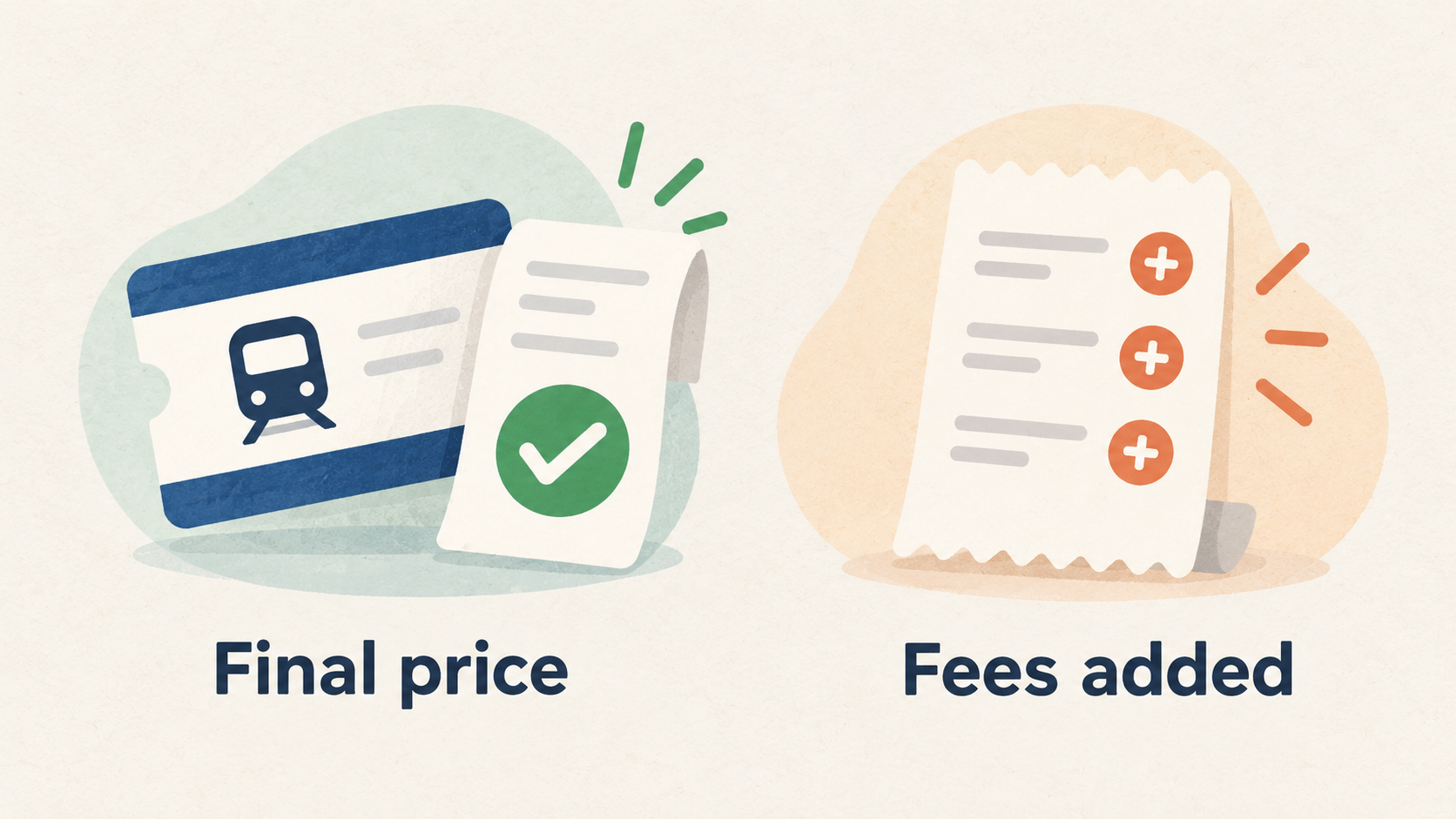
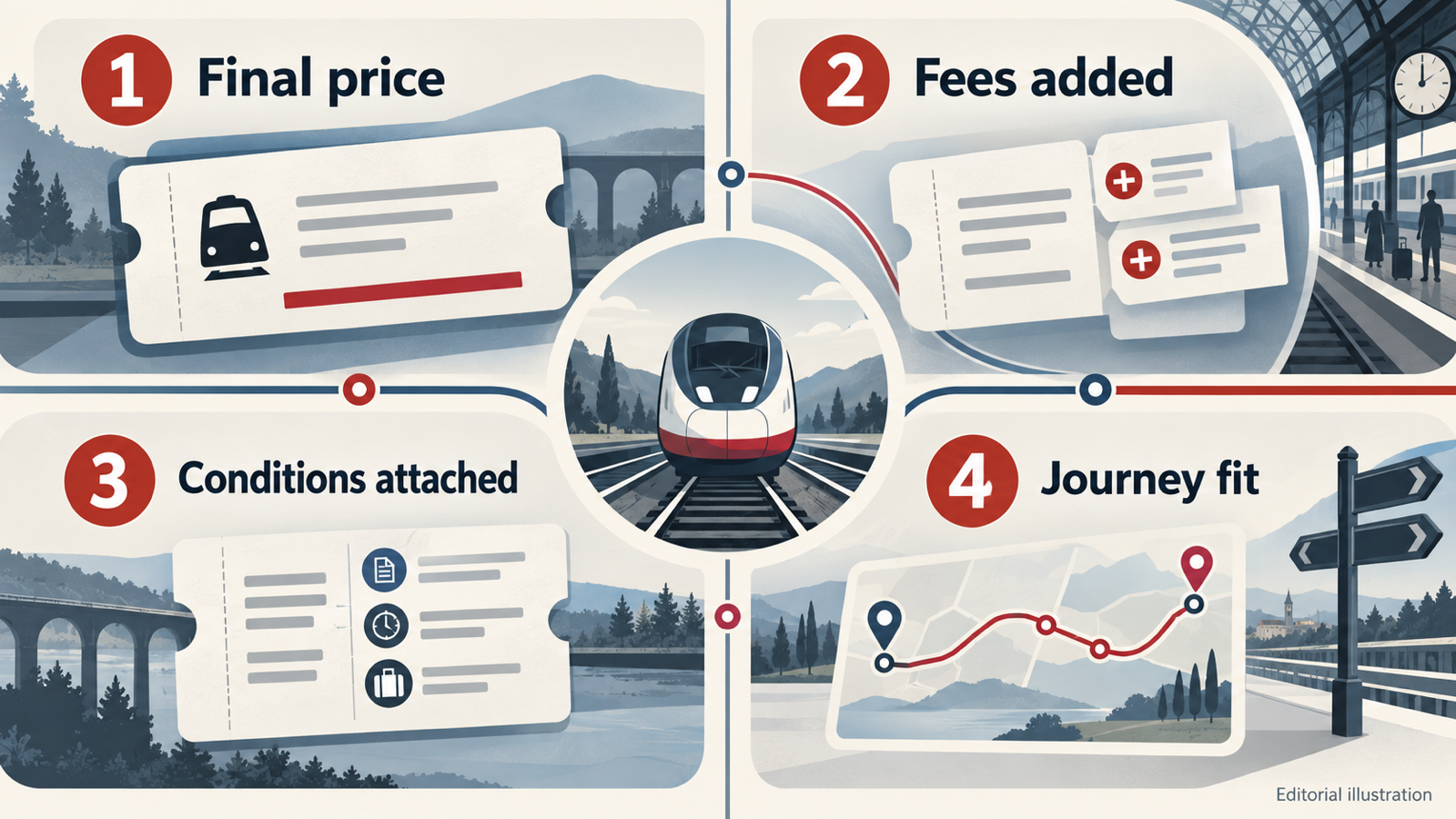
A genuine train ticket deal is one that is still cheaper once you add everything you will actually pay and account for the rules attached to the fare. A headline price is only the starting point. Four tests run through this guide:
- Final price: is the total at checkout lower than comparable options, not just the first price you were shown?
- Fees added: has the seller added booking, card or delivery fees on top of the fare?
- Conditions attached: does the saving depend on booking early, holding a railcard, travelling as a group, staying in a particular area or using a particular train?
- Journey fit: does the ticket actually suit the trip you are making?
Retailers tend to publish their best-case figures. Trainline's cheap tickets page is headed "Save up to 61% on Tickets", and Split My Fare says split tickets can offer savings of up to 90% off a fare. Both are maximums that apply to selected journeys, not promises for every trip.
This is editorial booking guidance built from published retailer, industry and regulator information. It is not based on personal testing of any booking site, and it does not rank the sources it describes.
Booking Fees and Drip Pricing
AI-generated illustration — not a retailer product photo.
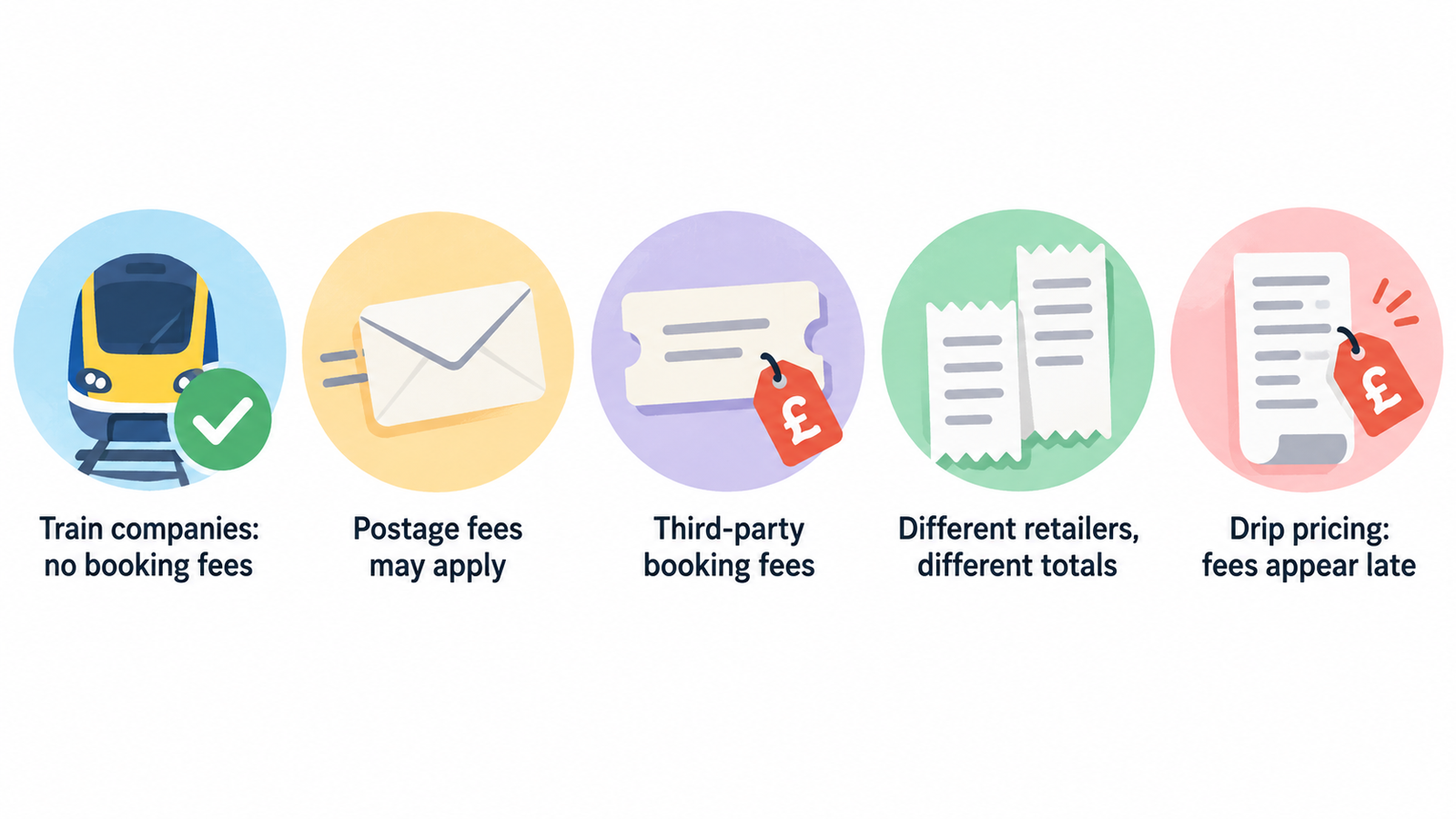
According to the Office of Rail and Road (ORR), train companies are not permitted to charge ticket booking fees, although they can charge certain fees, such as postage costs for ticket delivery. Many third-party ticket retailers do charge booking fees. That means the same journey can come with different totals depending on where you buy it, so the cheapest fare on screen is not always the cheapest ticket.
In a press release dated 11 December 2023, the ORR said it had reviewed the websites and apps of 19 third-party retailers and 21 train companies. The review identified concerns about "drip pricing", where fees appear late in the booking process rather than up front. The regulator wrote to seven third-party retailers about its concerns and said it planned to publish the letters and the retailers' responses. It said the key improvement it wanted was readily available, transparent and accurate fee information that people can read before they start booking.
That review is from 2023, so check the ORR's website for any later outcomes. The practical lesson still stands: compare the final price, not the first price shown.
Some retailers say they charge no fees. Split My Fare, for example, states: "We charge no booking or card fees on your tickets." That is the retailer's own claim, so confirm it in your basket.
To see fees early, look for a fees explanation before you begin a search. Then take each option as far as the basket stage, without entering payment details, and compare the totals.
Where Advance and Split Tickets Save Money
AI-generated illustration — not a retailer product photo.
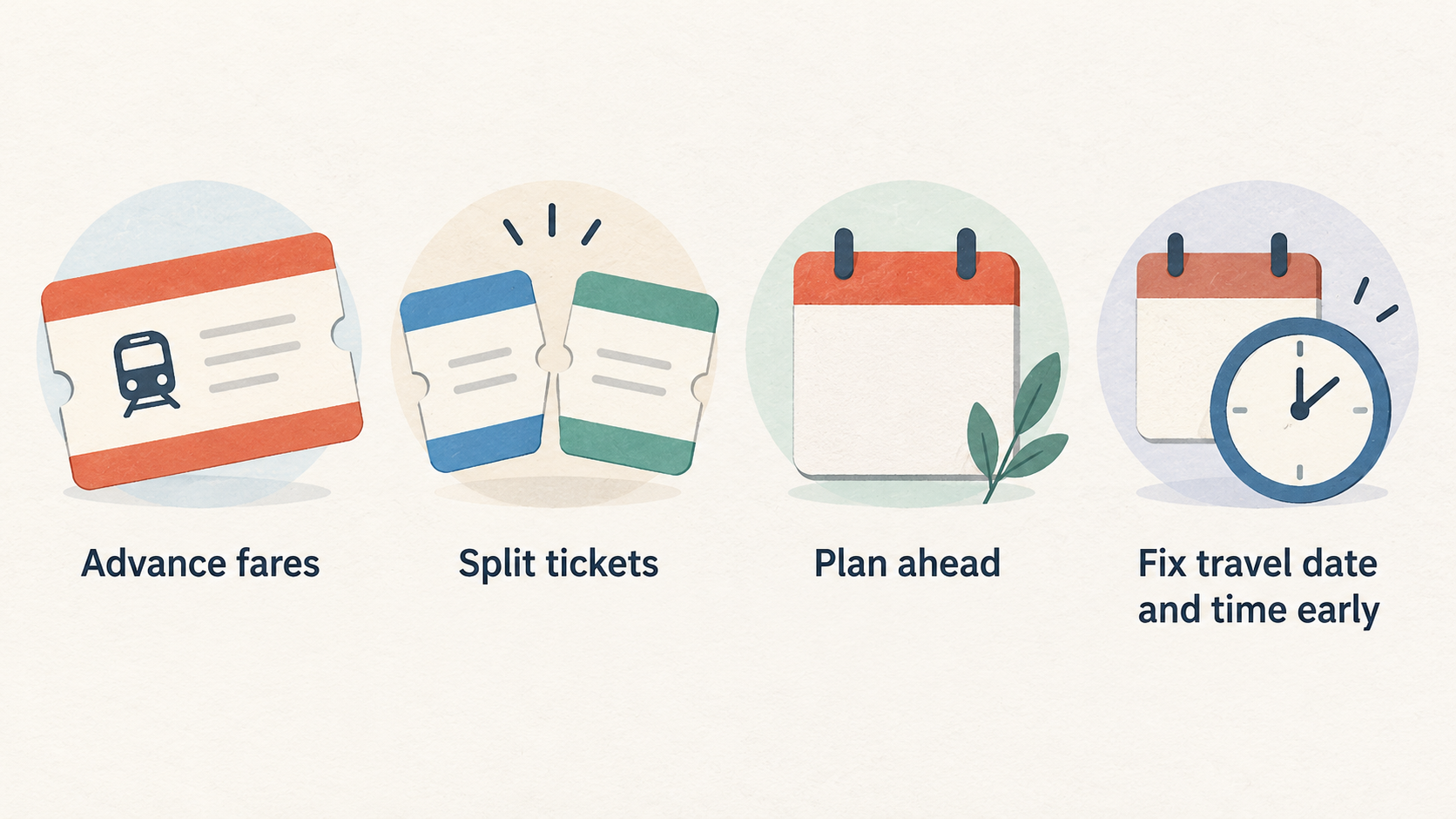
Advance fares and split tickets are two of the main tools retailers point to for cutting the cost of a journey. Here is what the sources say about each.
Advance tickets. Trainline states that train fares usually increase as the travel date approaches, and that Advance tickets are often cheaper than buying on the day of travel. Split My Fare says most Advance Tickets can be bought up to 12 weeks before a journey. The saving comes from planning ahead, so it rewards people who can fix their travel date and time early.
Split tickets. Split ticketing divides one journey into several tickets for smaller segments of the same route. Split My Fare says that, in most cases, you stay on the same train and do not need to change. It says splits can be applied across Singles, Returns and Season Tickets, and it claims savings of up to 90% on selected fares. Trainline also lists split tickets among its cheap-ticket tools.
These are retailer statements about what is possible, not guarantees. Whether a split or an Advance fare beats a standard ticket depends on your route, date and time, so run the search and compare the totals before you decide.
Where Cheap Fares and Split Tickets Fall Short
A low price can hide conditions that make the ticket a poorer choice for you.
Split tickets depend on where the train stops. Split My Fare states that the only requirement for split ticketing is that the train stops at each station shown on your tickets. If asked, you should show the correct ticket for the part of the journey you are travelling on. If the train you want does not call at a split station, the saving may not work for that service. Keep every ticket easy to reach during the trip.
Headline savings are maximums. Figures such as "up to 61%" and "up to 90%" describe the best case. They will not apply to every route, date or time.
Advance savings reward early booking. If you book close to the travel date, you may not see the discounts that early bookers get.
Refund and change rules vary. Conditions differ by ticket type and by retailer. The sources used for this guide do not set out refund, change or delay-repay rules, so none are stated here. Before buying a fare that is not flexible, check the terms with National Rail or the train operator.
Comparing Retailers and Offer Sources
Three kinds of source come up when people hunt for deals. This is a comparison of what each publishes about itself, not a test or a ranking.
- A large multi-operator retailer (Trainline). Trainline says you can compare prices and book train and coach tickets, including European routes. Its pages list railcards, split tickets and group tickets among its tools.
- A split-ticket specialist (Split My Fare). The site focuses on split tickets. It says it searches all its fares, including Advance and splits, and that it charges no booking or card fees. It also states savings of up to 90% on selected fares.
- A promotions listing (National Rail's Special Offers and Promotions page). This page lists operator promotions, railcard offers and Ranger and Rover tickets, and it can be filtered by train operator. It is a list of offers rather than a booking search.
Trainline and Split My Fare appear to operate as third-party retailers, so the ORR's points about fee transparency apply to the category. Check each basket rather than assuming a fee-free or fee-light result. A train operator's own site cannot charge booking fees, which makes it a useful price check.
Which source suits you depends on the trip. A single route with several possible split points suits a split search. A regional day out may be better served by browsing the promotions page. Comparing the final price on more than one source works for almost any journey.
Railcards, Group Discounts and Special Offers
Discount claims are only useful if you meet the conditions attached.
Railcards. Both Trainline and Split My Fare let you add a railcard when you search, so the discount is reflected in the price you see. A railcard is only a saving if the cost of the card is outweighed by the journeys you take with it. Card prices and terms are not covered by the sources used here, so check them with National Rail or the railcard provider before buying.
Group discounts. Split My Fare says groups of at least three passengers can save up to 34% with a GroupSave discount. As with other "up to" figures, treat that as the best case and check the price for your own group.
Ranger and Rover tickets. National Rail lists Ranger and Rover tickets that give travel in a designated area. Examples on its offers page include a Cardiff and Valleys Explore ticket offering a day of unlimited travel on Transport for Wales services in the designated area, and Island Line Day Ranger. These only pay off if your trips fit inside the area, so map out your journeys first.
Area- or card-specific promotions. Some promotions apply only to certain people or places. The MyCumbria Card, for example, is listed with a 34% discount. Check who is eligible and where it applies before counting it as a saving.
How to Read Up-To Savings Claims
"Up to" figures describe the best case. The examples in the sources are up to 61% (Trainline), and up to 90% and up to 34% (Split My Fare). Use these questions to judge whether a figure applies to you:
- What is the baseline? A percentage off what? Without a stated comparison fare, the number is hard to interpret.
- Is it a maximum? "Up to" means some journeys may see far less, or no saving at all.
- What conditions are attached? Early booking, a minimum group size and a railcard are all common requirements.
- Are fees included? A saving counts only after booking and card fees are added to the total. The ORR's drip-pricing concern is the reason to compare the final price, not the first price shown.
- Is the comparison like for like? To compare sources fairly, use the same journey, date, time, passengers and railcard on each.
If a claim fails any of these questions, treat it as marketing rather than as a measure of what you will pay.
A Pre-Purchase Checklist for Train Tickets
Run through these steps before you enter payment details.
- Search the same journey and passengers on more than one source. Include the train operator's own site, which cannot charge booking fees.
- Check the basket total. Look for booking, card and delivery fees before you pay.
- If you are using split tickets, confirm the train calls at every split station. Keep each ticket to hand in case you are asked to show it.
- Add any railcard. Then check group size and area conditions on any offers.
- Check refund and change terms for non-flexible fares. Do this with the operator or National Rail before buying, because those rules are not covered by the sources used for this guide.
- Book earlier where you can. Trainline says fares usually rise as the travel date approaches.
Frequently Asked Questions
Do train companies charge booking fees, and do third-party retailers?
According to the ORR, train companies are not permitted to charge ticket booking fees, although they can charge certain fees such as postage for ticket delivery. Many third-party retailers do charge booking fees, so the cheapest source depends on the total at the end of the booking, not the fare at the start.
Is split ticketing allowed, and what do I need to do when I use it?
Split My Fare states that the only requirement is that the train stops at each station shown on your tickets, and that you should show the correct ticket for the relevant part of the journey if asked. That is one retailer's description, so check the operator's terms for your journey.
Are Advance tickets always cheaper than buying on the day?
No source here says always. Trainline says Advance tickets are "often" cheaper than buying on the day, and that fares usually rise as the travel date approaches. Booking early often helps, but not every journey will have an Advance fare. Compare the options for your own trip.
Does an "up to" percentage saving mean I will get that discount?
No. "Up to" describes the best case on selected journeys, such as the up to 61% and up to 90% figures retailers publish. Your saving depends on your route, date, time, passengers and any railcard, and it only counts once fees are included. For points these sources do not cover, such as refund terms or railcard prices, check National Rail or the train operator.
Sources
Related reading
- Best UK train and coach ticket booking sites: evidence-led top choices
- Split My Fare review: who it suits and who should skip it
- Eurostar booking review: fares, travel classes and exchange rules
- When to book UK train and coach tickets for better value
Editorial information: About our editorial team · Read our editorial policy · Read our affiliate disclosure.