
AI-generated illustration — not a retailer product photo.
National Express at a Glance
AI-generated illustration — not a retailer product photo.
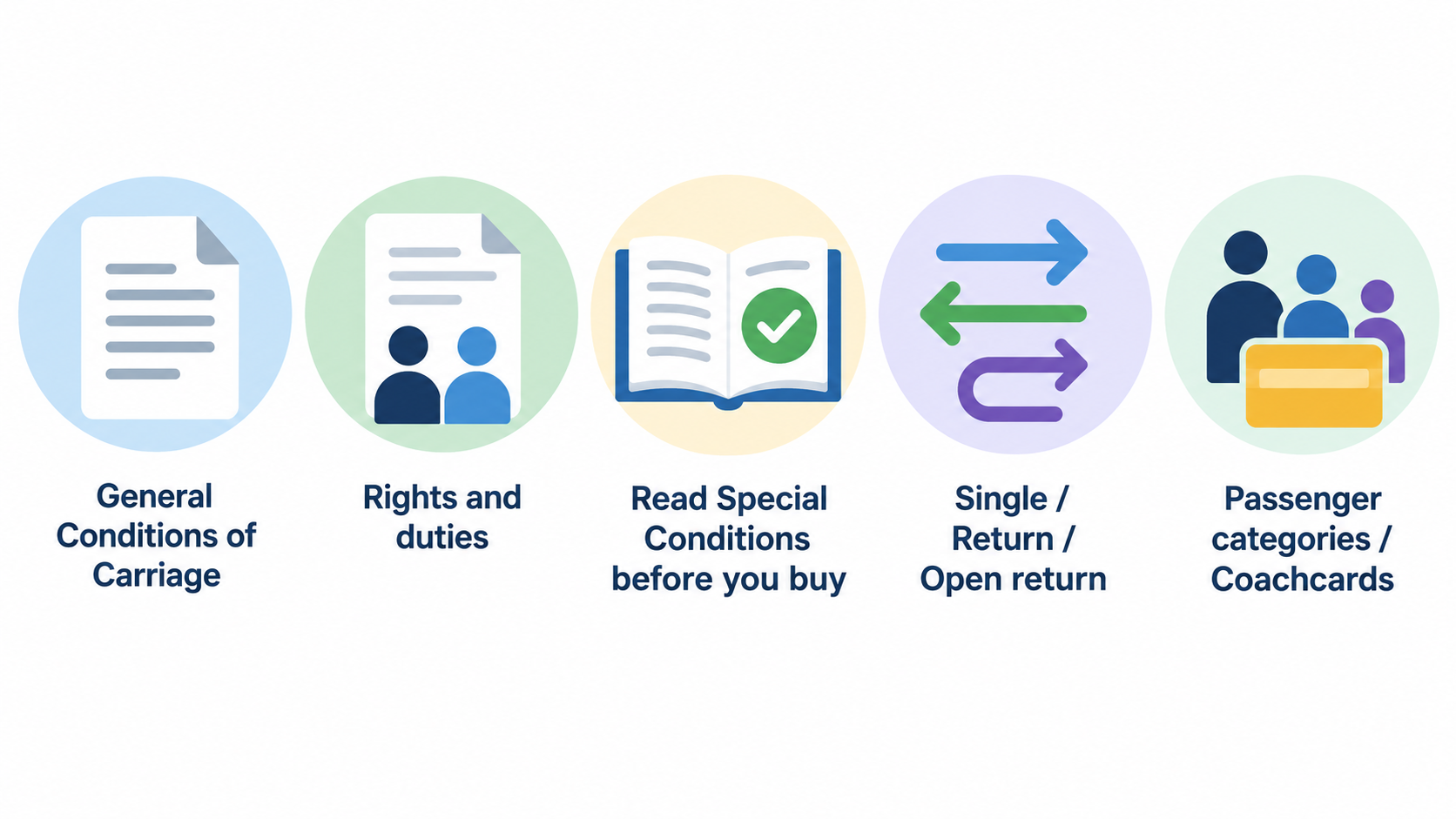
National Express is a coach operator whose services are governed by a published document: the General Conditions of Carriage. According to the operator's own help page, those Conditions apply to all of its services and set out your rights and duties as a customer. They also ask you to read them, along with any Special Conditions that apply to your ticket, before you buy.
On the booking pages, journeys can be searched as a single, a return or an open return. Passengers are chosen by category, and there is an option to add Coachcards. That makes the basic product easy to understand, and this guide walks through what the published pages say about each part.
It is written for UK travellers comparing ways to get from A to B by train, coach or, for continental trips, Eurostar. It is for people who want plain-English guidance on ticket types, discount cards and what happens when things go wrong. It is an editorial guide built from published terms, not a report of hands-on testing. It deals in what the rules say, not in how any particular journey feels.
If you are weighing coach against rail, the sections on ticket types, ages, disruption and the pre-payment checklist should help you decide whether National Express earns a place on your shortlist.
How This Review Was Built
This guide relies on National Express's own public material: its General Conditions of Carriage and the help and booking pages that describe tickets, passenger categories and Coachcards. Nothing here comes from personal journeys, and we do not claim to have run independent tests of any kind.
That shapes what the guide can and cannot tell you:
- What it can do: explain what the published terms and booking pages say, point out where they are clear, and flag where they are broad or inconsistent.
- What it cannot do: judge fares, punctuality, comfort or customer service. Those need real-world experience or live data that this review does not have.
Prices, offers and rules can change. The Conditions are amended from time to time, and booking pages can be updated. Treat this guide as a starting point and confirm the details shown at the point of booking before you pay.
Where the sources differ, we say so instead of quietly choosing one version. The clearest example is the way passenger age bands are labelled on different pages, covered below.
Where National Express Works Well
The published sources support a handful of genuine strengths. None of them needs superlatives, because they are mostly about clarity.
A simple ticket structure. The booking form offers single, return and open return in one place, so you do not have to hunt for the right product before you start a search.
A defined child fare band. The Conditions define a Child Ticket as one for a child aged between 3 and 15 inclusive who qualifies for a discounted fare. Families can see at a glance who falls into that band.
Written rules for young travellers. The booking pages state in plain terms what applies to unaccompanied children. Under-14s need a responsible person, and 14 and 15 year olds have set time limits. You do not need to dig through legal wording to find this.
Terms you can read before buying. The full Conditions of Carriage are published online. They explain who the operator is, how the contract can be changed or ended, and what to do if there is a problem. Being able to read your rights before paying is a real advantage when you are choosing between operators.
A route to savings. Coachcards can be added during the passenger step of booking. The sources reviewed here do not state what a Coachcard costs or saves, so we cannot say how much it helps. It is, however, a visible option for travellers who want to look for a discount. If you are used to railcards, it is worth comparing how the two types of card work.
Where It Falls Short or Needs Care
Several points deserve care before you book.
Broad wording on events beyond control. The Conditions define "Circumstances Beyond Our Reasonable Control" widely. The list includes traffic delays, road works, adverse weather, strikes and industrial action, and breakdowns or technical problems with a coach, and it is introduced as including those items "without limit". Because that covers many everyday causes of delay, it is worth reading before you rely on a tight connection.
A three-month return window. The booking form tells you to select a return within 3 months of your outward travel. If your plans are uncertain or long-range, that limit matters.
Restrictions on unaccompanied children. Children under 14 cannot travel without a responsible person aged 16 or over for the whole journey. Children aged 14 to 15 may travel alone only from 5am, arriving no later than 10pm. They may be asked for proof of age or a signed letter of permission.
Inconsistent age labels. One view of the passenger selector shows Adults (2+) and Infant (0-1). Another shows Adults (16+), Children (3-15) and Infant (0-2). The difference may come from different page versions, but we cannot say which applies to your booking. Check the figures shown at checkout.
What this review cannot assess. We have not tested fares, punctuality or comfort, so we cannot say how National Express compares with rail or other coach companies on those points.
Ticket Types Explained: Single, Return and Open Return
AI-generated generic editorial illustration — not a retailer product photo and does not depict the reviewed product or service. Help readers match Single, Return and Open Return tickets to their travel plans at a glance.
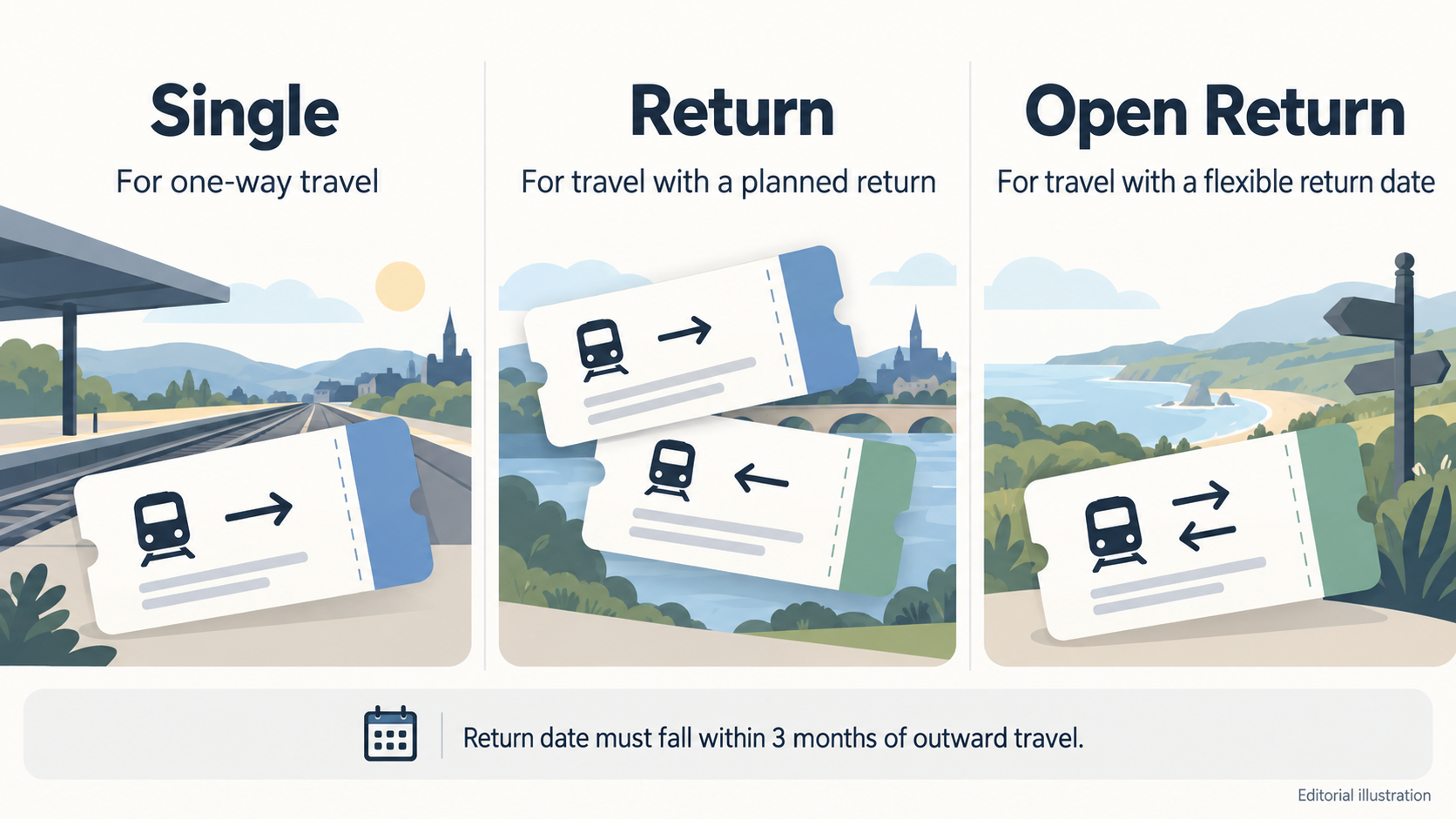
The search form offers three journey types.
- Single: one journey in one direction. It suits one-way trips, or travellers who want to choose a different operator or mode for the way back.
- Return: an outward and a return journey booked together. You pick a return date and time, and the form offers quick options such as same day or next day.
- Open Return: a return option on the same form. The pages reviewed here do not spell out its detailed rules, so read the terms shown for your ticket and confirm how the return part works.
For any return, the form says to select a return within 3 months of your outward travel. That is the one limit we can state with confidence from the booking pages.
The form also asks you to choose whether a time is when you want to depart or when you want to arrive. The page advises that, for best results, you should select a time. Leaving the time blank may give you a less useful set of results.
Special Conditions may apply to particular tickets in addition to the General Conditions, so read the terms attached to the ticket you choose.
Finally, do not assume rail rules apply. Ideas such as split ticketing are mainly a rail topic, and the sources used here do not describe them for National Express coaches. If you are used to train fares, check how flexibility works on the coach ticket in front of you.
Travelling with Children and Young Passengers
The booking process asks you to select adults, children and infants separately, so family bookings are broken down by category from the start.
Child Tickets. The Conditions define a Child Ticket as being for ages 3 to 15 inclusive. The passenger selector shows Children (3-15) alongside Adults (16+) and Infant (0-2).
Under-14s. Children under 14 are not permitted to travel unless accompanied throughout the journey by a responsible person aged 16 or over.
Ages 14 and 15. These passengers may travel unaccompanied, but only from 5am, and they must arrive at their booked destination no later than 10pm. A late-evening journey that arrives after that time falls outside the rule as published.
Proof and permission. Unaccompanied children will be asked for proof of age or a signed letter of permission. A parent arranging a teenager's trip should have one of these ready.
Check the age bands. As noted above, another view shows Adults (2+) and Infant (0-1). The differences are small, but they matter if your child is close to a boundary, such as a two-year-old. Rely on the figures presented at checkout, and if you are unsure, read the Conditions or contact the operator.
If you are comparing family costs with rail, a guide to railcards and family discounts is a useful companion.
Coachcards and Ways to Keep Costs Down
The evidence for this section is narrow, so we keep it narrow. The booking form includes an "Add Coachcards" option in the passenger step, so you can add one as you choose who is travelling.
This guide does not state Coachcard eligibility, price or discount level, because those details are not in the sources we reviewed. Check the official Coachcards page for the current terms before deciding whether one is worthwhile.
A few practical habits can help you compare costs without relying on any figures here:
- Be flexible with dates and times. The form lets you search by departure or arrival time, so trying different times may show different options.
- Enter every passenger category correctly. Selecting adults, children and infants accurately means the options you see reflect your actual party.
- Compare beyond one operator. Booking fees and ticket rules differ across sites and modes. A quick look at rail and other coach options is sensible, especially on routes served by more than one.
None of these steps guarantees a saving. They are simply sensible ways to make a fair comparison.
Delays, Disruption and the Conditions of Carriage
The Conditions explain how the contract between you and National Express can be changed or ended and what to do if there is a problem. For disruption, the key concept is "Circumstances Beyond Our Reasonable Control".
The definition covers any circumstances that affect the operator's, or any Partner Operator's, ability to provide services and that are beyond its reasonable control. The list is introduced as including, without limit:
- accidents or other incidents on or affecting roads;
- adverse weather conditions;
- unforeseen traffic delays or congestion and road works;
- strike or industrial action;
- breakdown or technical problems with a coach;
- actions by or compliance with requests of the Police or other authorities; and
- problems or delays caused by other customers or passengers.
Because the definition extends to partner operators, it is not limited to services run directly by National Express.
What does this mean for you? These circumstances affect how the operator treats disruption. If your coach is delayed by traffic or weather, do not assume a particular outcome on compensation. Check your expectations against the full terms.
We do not summarise refund or change rights here, because the section of the Conditions we reviewed does not let us do so accurately. Read the official Conditions of Carriage, and any Special Conditions on your ticket, for the full position. A guide to refund rules and delay rights across trains, coaches and Eurostar can help you compare.
Booking Checklist Before You Pay
AI-generated generic editorial illustration — not a retailer product photo and does not depict the reviewed product or service. Give readers a scannable pre-payment checklist and a prompt to consider rail or Eurostar when the trip suits them better.
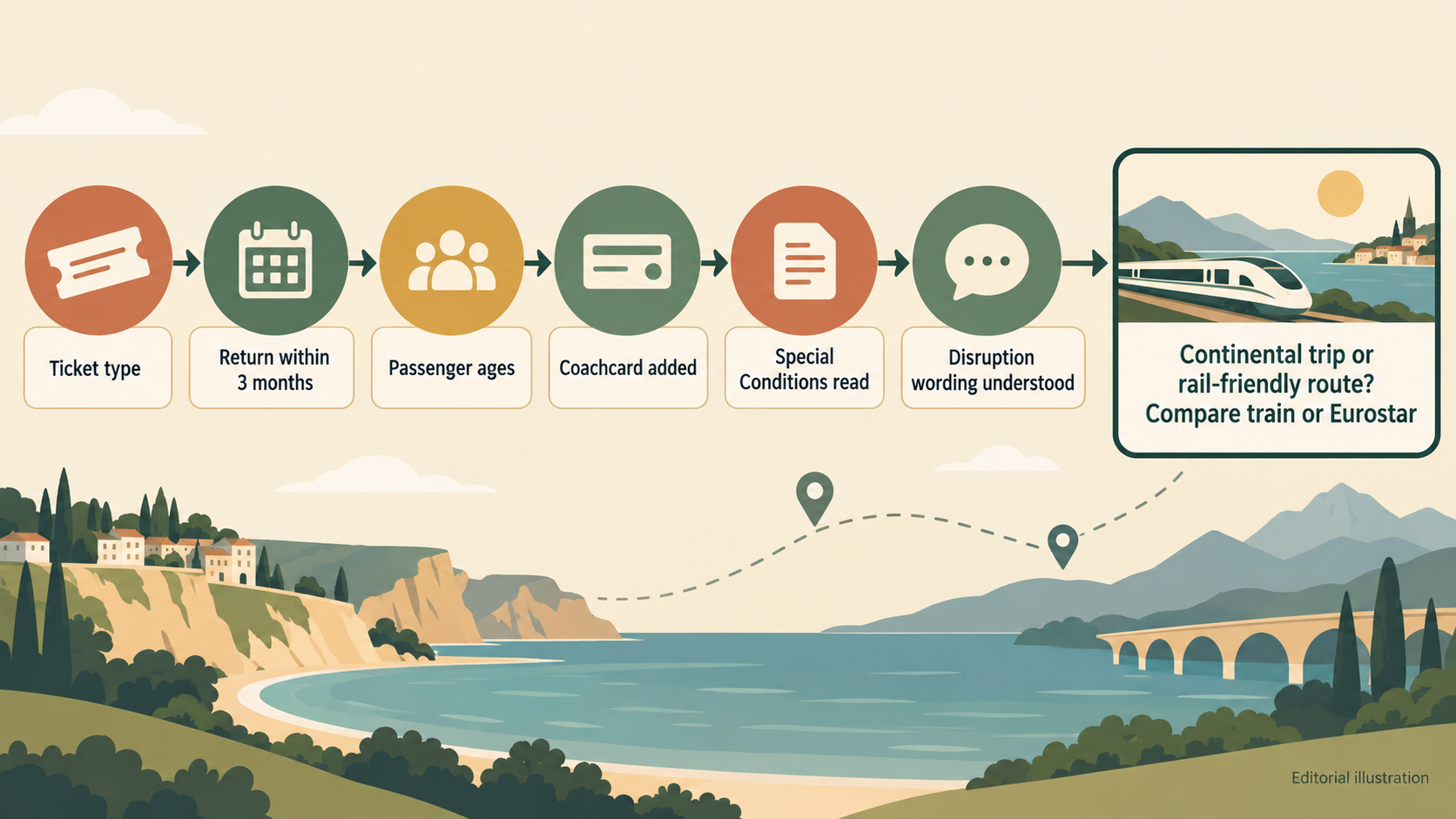
Run through these steps before you confirm a National Express booking:
- Ticket type. Confirm whether you need a single, return or open return.
- Return window. If you are buying a return, make sure the return falls within 3 months of your outward travel.
- Passenger categories. Select adults, children and infants correctly, and check the age bands shown at checkout, since labels differ between pages.
- Unaccompanied children. If a 14 or 15 year old is travelling alone, check the 5am start and 10pm arrival limits, and prepare proof of age or a signed letter of permission.
- Coachcard. Decide whether one is relevant and verify its terms on the official Coachcards page.
- Special Conditions. Check whether any apply to your ticket.
- Disruption wording. Read the Conditions on events beyond reasonable control before relying on a tight connection.
Finally, consider the journey itself. For a trip to the continent, or a route where rail is a natural fit, compare train or Eurostar options before booking. Coach is not always the best choice, and the right answer depends on your route and priorities.
Frequently Asked Questions
What ages count as a child on National Express?
The Conditions define a Child Ticket as one for a child aged between 3 and 15 inclusive who qualifies for a discounted fare. The passenger selector shows Children (3-15). Check the age bands shown at checkout, because other views label adults and infants slightly differently.
Can a 14 or 15 year old travel on National Express alone?
Yes, within limits. Children aged 14 to 15 may travel unaccompanied, but only from 5am, and they must arrive at their booked destination no later than 10pm. They may be asked for proof of age or a signed letter of permission. Children under 14 must be accompanied throughout the journey by a responsible person aged 16 or over.
How long do I have to use the return part of a ticket?
The booking form says to select a return within 3 months of your outward travel. For details on how an open return works, read the terms shown for your ticket and any Special Conditions that apply.
What happens if my coach is delayed by traffic, weather or a strike?
The Conditions list traffic delays, adverse weather, road works, strikes and breakdowns among the Circumstances Beyond Our Reasonable Control. These affect how the operator treats disruption. This guide does not summarise refund or compensation rights, so read the full Conditions of Carriage to see what applies to you.
Can I add a Coachcard when I book?
Yes. The booking form has an option to add Coachcards in the passenger step. Eligibility, price and discount level are not covered in this guide, so check the official Coachcards page for current terms.
Sources
Related reading
- Best UK train and coach ticket booking sites: evidence-led top choices
- Eurostar booking review: fares, travel classes and exchange rules
- When to book UK train and coach tickets for better value
- UK rail ticket types explained: Advance, Off-Peak, Anytime and railcards
Editorial information: About our editorial team · Read our editorial policy · Read our affiliate disclosure.