
AI-generated illustration — not a retailer product photo.
Which UK rail ticket type fits your journey?
AI-generated illustration — not a retailer product photo.
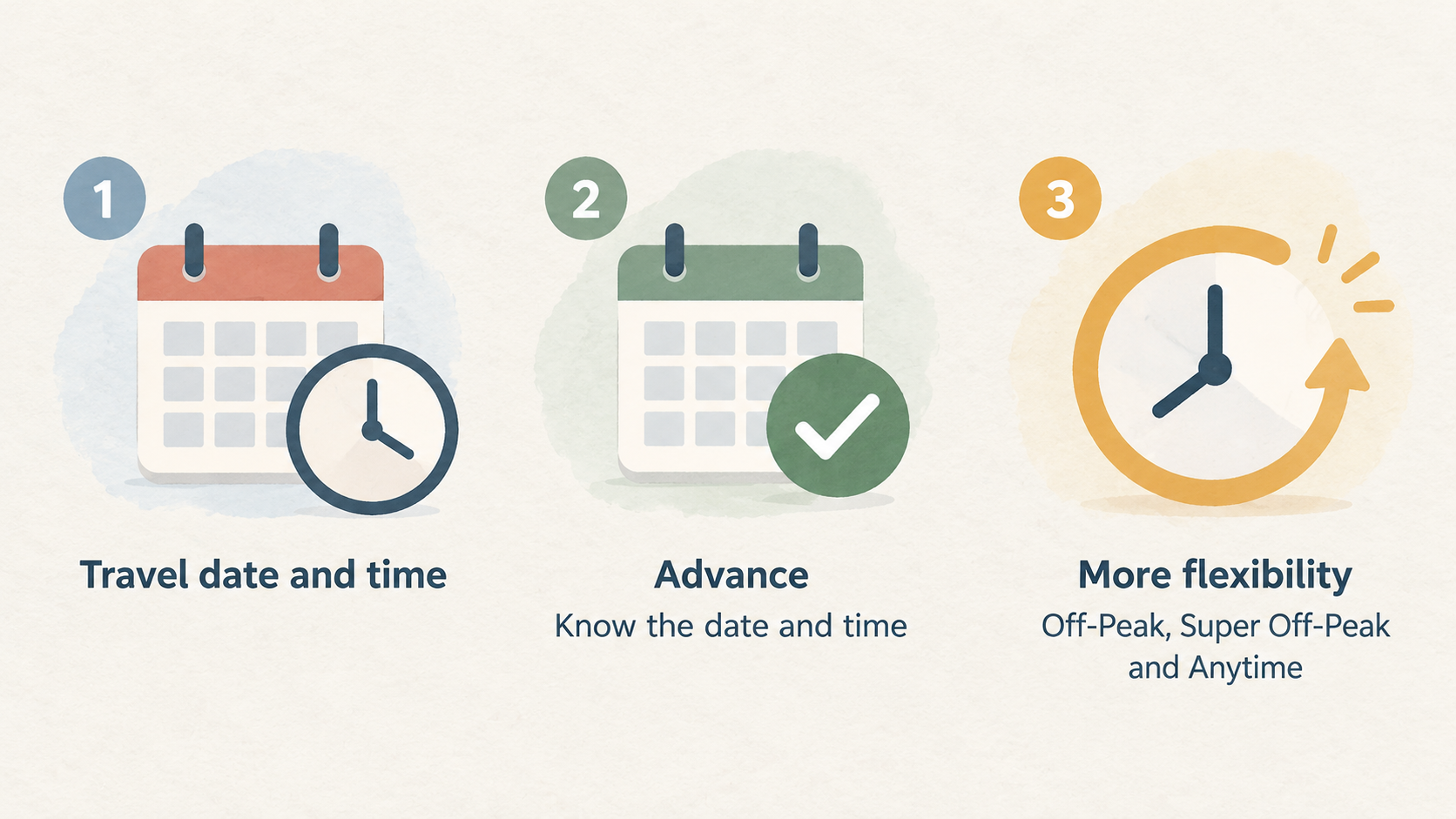
The quickest way to narrow down a UK rail ticket is to ask one question: how fixed are your travel date and time? National Rail's guidance on buying a ticket splits the main choices on exactly that point.
If you know the date and time you want to travel, National Rail says an Advance ticket will be suitable. If you want more flexibility, it points to Off-Peak, Super Off-Peak and Anytime tickets, because you are not limited to a specific date or train.
Other ticket families exist too. Season and Flexi Season tickets offer unlimited travel between two stations and are normally available weekly, monthly or yearly. Rover and Ranger tickets are also listed on the same National Rail page. These serve different needs, so this guide concentrates on Advance, Off-Peak and Anytime tickets.
Railcards sit on a separate layer. A Railcard is not a ticket type. It is a discount card applied to eligible fares, and the Railcard operator advertises 1/3 off rail travel. Later sections cover which Railcard may suit you.
This is editorial guidance drawn from published information from National Rail and the Railcard operator. It is not based on personal testing, so confirm fares and terms when you book.
Advance, Off-Peak and Anytime tickets compared
AI-generated illustration — not a retailer product photo.
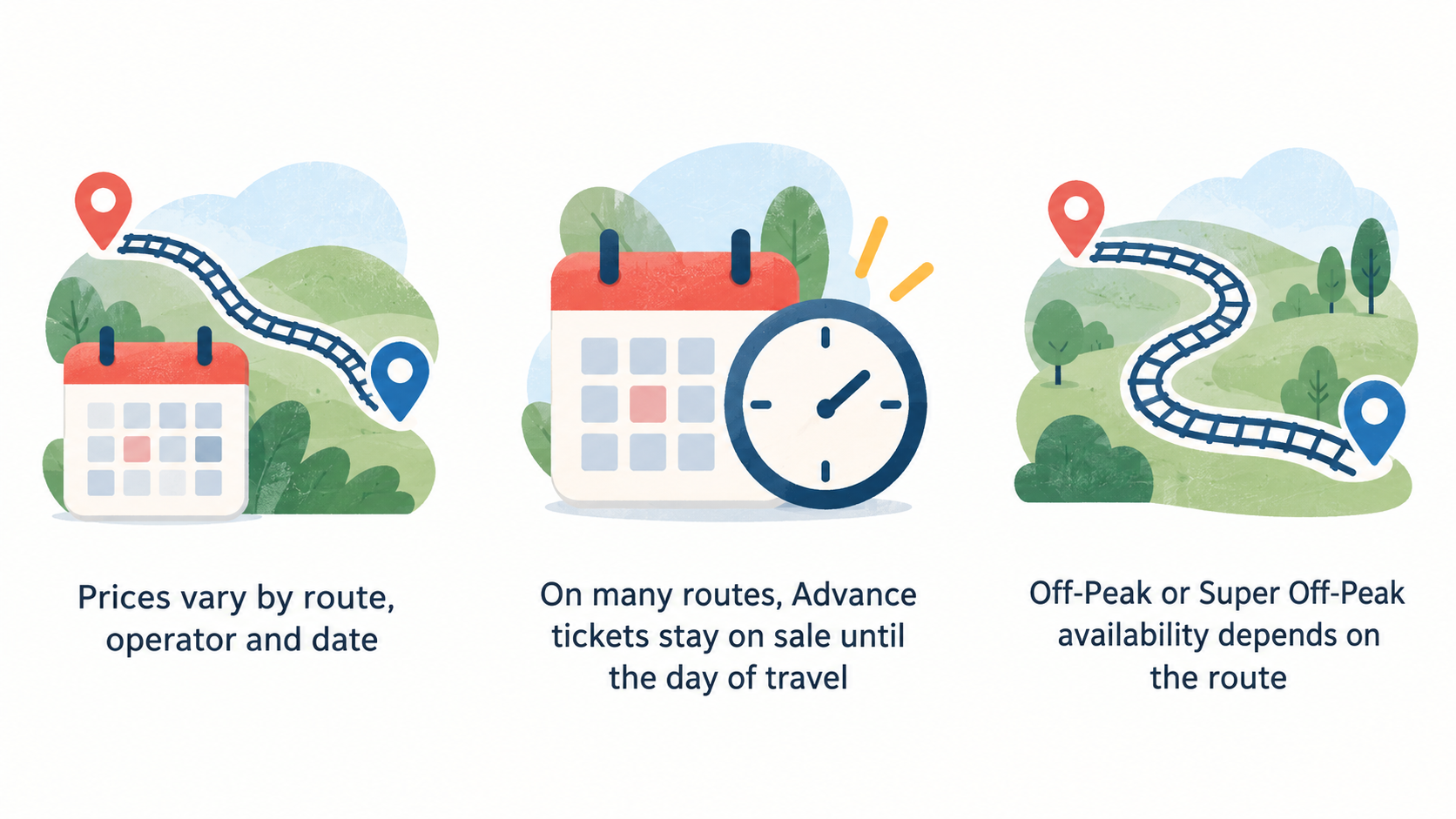
The table below sets out how National Rail describes the three core ticket types. It deliberately contains no fares, because prices vary by route, operator and date.
| Advance | Off-Peak and Super Off-Peak | Anytime | |
|---|---|---|---|
| Validity | Only on the date and train specified | Any permitted train during off-peak hours | Any permitted train, at any time |
| Flexibility | Lowest: tied to one train | Moderate: free choice of train within off-peak hours | Highest: no time restriction |
| When to buy | In advance; usually up to 12 weeks ahead, and on many routes until the day of travel | At any time | At any time |
| Typical use | You know exactly when you want to travel | Your journey falls outside peak hours | Your timing is uncertain or cannot be moved |
A few points are worth knowing. On many routes Advance tickets stay on sale until the day of travel, and sometimes up to 10 minutes before departure, so they are not only for early planners. Whether an Off-Peak or Super Off-Peak ticket exists for your journey depends on the route. National Rail says that if one is available, journey planners will make it available to purchase.
The sourced National Rail page does not set out exact fares or refund and change conditions. Those vary by ticket and operator, so check them at the point of booking.
Where Advance tickets work well
AI-generated illustration — not a retailer product photo.
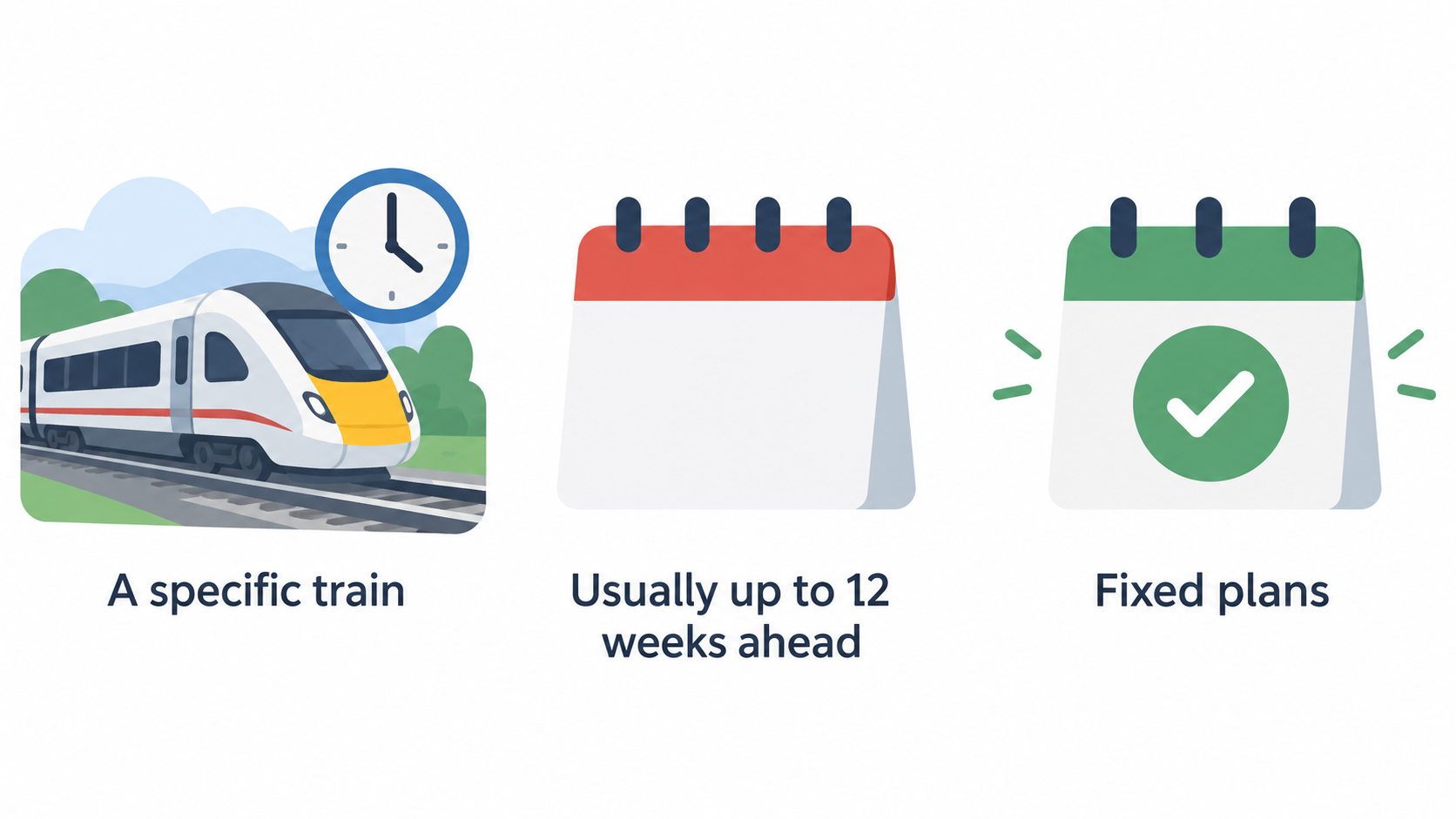
National Rail describes Advance tickets as a great deal if you know exactly when you want to travel. That is the core of the case for them: you commit to a specific train and, in return, get a ticket aimed at travellers with fixed plans.
The booking window helps planners. You can usually buy an Advance ticket up to 12 weeks ahead, which lets you secure a specific train early. That suits a booked-in event, a work trip with a set meeting time or a holiday with fixed dates.
They are not only for people who plan far ahead, though. On many routes Advance tickets remain available until the day of travel, and sometimes until 10 minutes before departure. If you know which train you will catch, it is worth checking whether one is still on sale.
One caution: the official wording describes a "great deal", not a guaranteed saving on every route. Do not assume a particular percentage off. Compare the Advance fare with the Off-Peak and Anytime options your journey planner shows for the same trip.
Where each ticket type falls short
Each ticket type asks you to give something up.
Advance: the ticket is only valid on the date and train specified. If your plans may change, that limited flexibility is the main drawback. The sourced pages do not set out refund or change rules in detail, so read the operator's terms before buying.
Off-Peak and Super Off-Peak: travel is restricted to off-peak hours, so a train that departs too early will not qualify. These tickets may also not be offered on every journey, which is why the journey planner result matters.
Anytime: these give the most freedom, because they allow any permitted train at any time. National Rail describes Advance as a great deal and Off-Peak as good value, but describes Anytime in terms of freedom rather than value. Treat the extra flexibility as the trade-off, and compare the fares shown for your route.
Railcards: a discount does not automatically apply everywhere. The Railcard operator lists conditions for individual cards. Two Together has a weekday time restriction, and the Network Railcard's eligible ticket types are subject to terms and conditions. Check the terms for the specific fare you plan to buy.
Off-Peak hours and when they apply
In general, National Rail says Off-Peak hours begin at 09:30 from Monday to Friday in cities and large towns, and at 09:00 everywhere else. If your train is scheduled to depart after the relevant time, you can travel with an Off-Peak ticket. Weekends and bank holidays are Off-Peak all day.
The wording matters: it is the scheduled departure time of your train that counts. A practical check is to look at the departure time of the specific service you want, not the time you plan to arrive at the station.
"In general" is also a deliberate caveat. Restrictions can vary by route, so treat the journey planner result for your trip as the final check rather than relying on the general rule.
Railcards can add their own timing conditions on top. The Two Together Railcard, for example, is for travel after 09:30 on weekdays, or at any time at weekends and on public holidays.
How Railcards work and what they cover
A Railcard gives a discount on eligible rail fares. National Rail and the Railcard operator both state 1/3 off rail travel, and the 16-17 Saver offers 50% off most train fares. National Rail lists 9 different Railcards and a comparison table of prices for 1-year and 3-year options. Because prices change, check the current figures on the official site rather than relying on any quoted here.
Some Railcards have their own twists:
- Family & Friends Railcard: 1/3 off for adults and 60% off for children, for up to 4 adults travelling with up to 4 children.
- Disabled Persons Railcard: 1/3 off for the cardholder and an adult companion.
Format varies. Many Railcards can be digital or physical, while the 26-30 Railcard is digital-only. A digital Railcard can be stored on up to 2 devices through the Railcard app.
You can buy or renew through the official Railcard site, and retailers such as Trainline also sell and renew digital Railcards. The official site says you can renew up to 30 days before your Railcard expires. If you buy through a retailer, compare any booking fees against the official site before you pay.
Which Railcard fits your age and travel pattern
The official Railcard selector asks three questions, and so does the retailer version: how old you are, who you usually travel with, and whether you travel within London and the South East. The options below follow that order.
By age
- 16-17 Saver: for ages 16 to 17.
- 16-25 Railcard: for ages 16 to 25, plus mature students. According to the Railcard site, you can buy before your 24th birthday and use it for 3 years.
- 26-30 Railcard: for ages 26 to 30, digital-only.
- Senior Railcard: for anyone aged 60 and over.
By who you travel with
- Two Together Railcard: for two people who travel together regularly. Travel is after 09:30 on weekdays, or at any time at weekends and on public holidays.
- Family & Friends Railcard: for up to 4 adults travelling with up to 4 children.
By region
- Network Railcard: for anyone aged 16 or over who travels across London and the South East. The Railcard site says it is eligible for a wide range of ticket types, including Anytime tickets, Off-Peak tickets and Travelcards, subject to terms and conditions.
By circumstance
- Disabled Persons Railcard and Veterans Railcard: these apply to eligible people, so check the eligibility criteria before buying.
Is a Railcard worth it? It pays for itself only if the discount on the trips you take adds up to more than the card's cost. The official sites say a Railcard pays for itself "in no time", but that depends on how often you travel and which fares you buy. Add up your likely journeys over the card's term, then compare that with the current price on the official site.
A practical path to choosing and buying
Here is a sensible order for the decisions.
- Decide how fixed your plans are. If the date and train are fixed, start with Advance. If they are flexible, look at Off-Peak, Super Off-Peak or Anytime.
- Check the journey planner for your route. It shows which ticket types, and which Off-Peak options, are actually offered for your journey. Check the departure time against the off-peak hours.
- Consider a Railcard only where it applies. Check that the card's terms cover the fare you have chosen, and that the discount is likely to recoup the cost.
- Compare where to buy. The official Railcard site and retailers can differ on format, renewal options and any booking fees. Compare them before you pay.
This is editorial guidance drawn from published terms. It is not the result of personal testing, and the details on the official sites are the final word.
Frequently Asked Questions
Can I use an Advance ticket on a different train from the one I booked?
National Rail describes Advance tickets as only valid on the date and train specified. Check the operator's terms for whether any change is possible before you book, because the sourced pages do not set out change rules.
What time does an Off-Peak ticket become valid on weekdays?
In general, Off-Peak hours begin at 09:30 from Monday to Friday in cities and large towns, and at 09:00 everywhere else. Your train must be scheduled to depart after that time. Weekends and bank holidays are Off-Peak all day. Restrictions can vary by route, so check the journey planner.
How much does a Railcard save and is it worth buying?
Railcards give 1/3 off most eligible rail travel. The 16-17 Saver gives 50% off most fares, and the Family & Friends Railcard gives 60% off for children. Whether it is worth buying depends on how often you travel: it pays for itself only if the discount on your trips exceeds its cost. Check current prices and terms on the official site.
Can I buy a digital Railcard, and how many devices can I use it on?
Many Railcards can be digital or physical, and the 26-30 Railcard is digital-only. National Rail says a digital Railcard can be stored on up to 2 devices.
Can I renew my Railcard early?
Yes. The official Railcard site says you can renew up to 30 days before your Railcard expires. Prices and terms change, so confirm the current details on the official site.
Sources
Related reading
- Trainline review: booking fees, split tickets, railcards and alternatives
- National Express review: practical coach booking assessment
- How to choose a UK train ticket booking site: fees, split tickets and refunds
- When to book UK train and coach tickets for better value
Editorial information: About our editorial team · Read our editorial policy · Read our affiliate disclosure.